Você está no 3DFinder
Buscamos em Thingiverse, MakerWorld e Printables ao mesmo tempo para te dar o melhor de cada uma.
Descrição
forceX assembly instructions ====================
(3D-printed v.1)
I. Resources and further reading
The forceX setup is a reproducible advancement of the design introduced by Herrel et al. (1999) and was published in the following article:
The ‘forceR’ package for closing force analyses (written in the programming environment R (R Core Team, 2021)) is available at CRAN.

A video of the assembly instructions is available on Youtube: https://youtu.be/xabIewPMVuU
II. Parts lists for forceX measurement unit
Table 1: 3D-printed components. All components should be printed in PLA filament, since this material is less flexible than other common materials like ABS, ASA or PETG.
| component | amount |
|---|---|
| base plate | 1 |
| main body | 1 |
| lever | 1 |
| microscope flange | 1 |
| microscope slider | 1 |
| bottom tip element holder | 1 |
| cam holder back | 1 |
| rod connector | 2 |
| rod cam connector | 1 |
| M5 knob | 7 |
Table 2: Generic components.
| component | amount |
|---|---|
| M1 bolt 3 mm | 6 |
| M1 hex nut | 6 |
| M2 threaded rod 16 mm | 1 |
| M2 hex nut | 1 |
| M2 bolts (from microscope) | 3 |
| M2 washers (from microscope) | 3 |
| M3 bolt 16 mm | 10 |
| M3 hex nut | 5 |
| M5 hex bolt 20 mm | 4 |
| M5 hex nut | 2 |
| M5 wing nut | 2 |
| M5 washer | 2 |
| 12 mm diameter rod (e.g. aluminum pipe) | s.b. |
| AA battery | 2 |
| flexible cable (1-core & 2-core) |
The 12 mm diameter rod should be cut into the following pieces:
- main rod: 90 mm
- microscope rod: 100 mm
- camera module rods: depending on focal range of camera. We used two 100 mm rods for a 5-MP RPi Camera (B) rev. 2.0 with adjustable focus (Waveshare, Shenzhen, China).
Table 3: Off-the-shelf and custom components.
| component | amount |
|---|---|
| Kistler 9215A | 1 |
| Kistler 1651C1 | 1 |
| microscope (e.g. Bresser Junior Stereo 3D) | 1 |
| tip element | 2 |
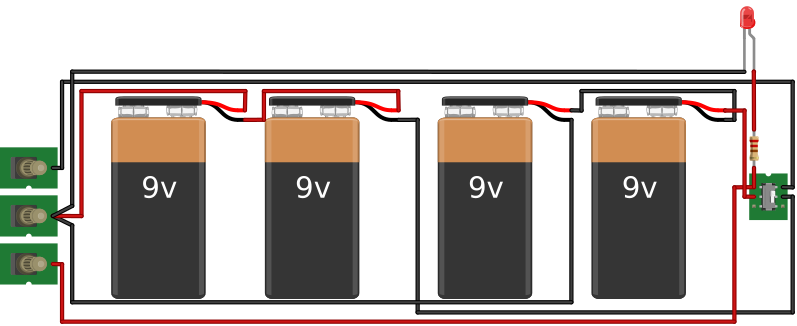
III. Parts list for power source
Table 4: Parts lists for power source.
| component | amount |
|---|---|
| box | 1 |
| banana jack | 3 |
| 2-way toggle switch (e.g. Eledis 1A series) | 1 |
| LED: red, 3 mm, 3V, 15mA | 1 |
| resistor: 9.1 kΩ | 1 |
| 9 V battery clip connector | 4 |
| 9V battery | 4 |
| 1-core flexible cable |
IV. Parts list for charge amplifier
For the parts list of the analog charge amplifier see IX. Schematics of custom electronics: Charge amplifier. For help in building this device, please contact M. Dübbert (Scientific Electronics & Experimental Design, Group of Prof. Büschges, University of Cologne).
V. Additional parts
Table 6: Additional parts list.
| component | amount |
|---|---|
| LabJack U3-HV | 1 |
| cable: circular 3-pin connector plug (e.g. GTX12-3) to 3 x male banana plugs | 1 |
| cable: BNC connector to 2-threaded wire | 1 |
| cable: USB type-A to USB type-B | 1 |
VI. Assembly instructions
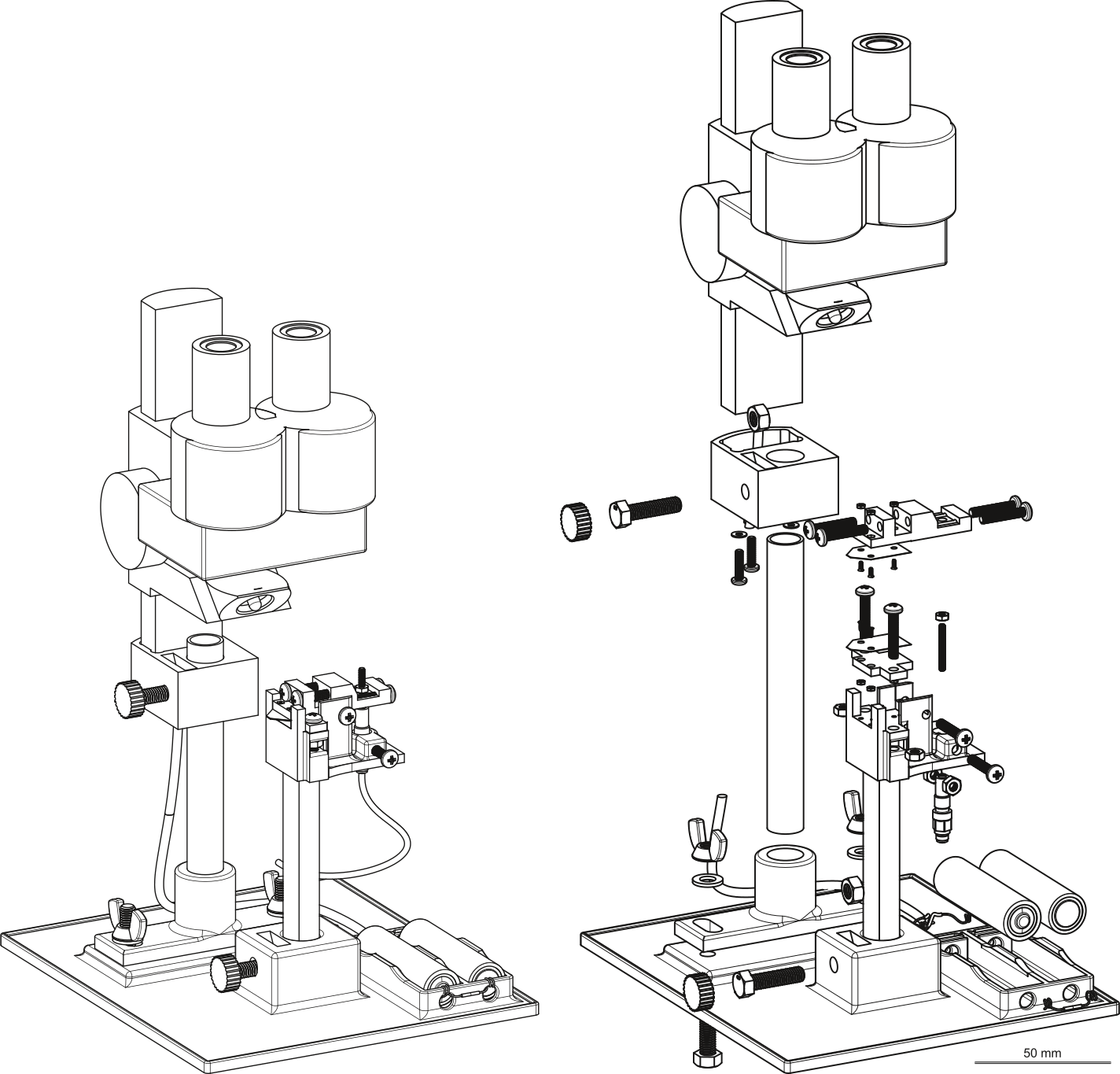
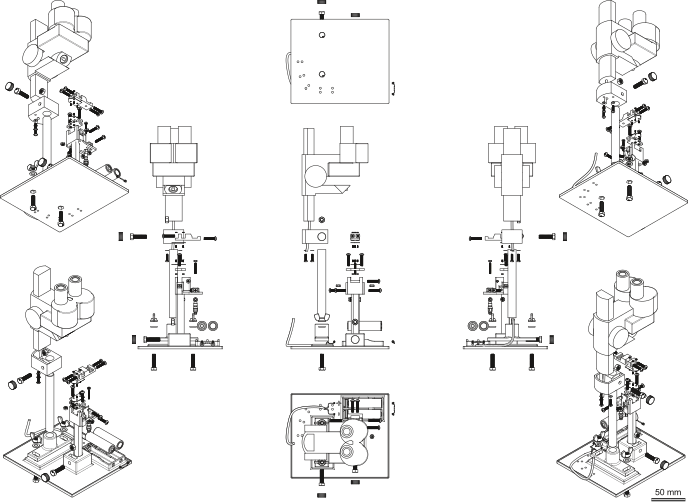
The following pages will guide you through the assembly of the forceX measurement system. At the end of this document you will find overview drawings of the whole setup and photos of additional components such as the custom charge amplifier and power source.
Step 1
| part | amount | type |
|---|---|---|
| main body | 1 | printed |
| M3 bolt 16 mm | 1 | generic |
Screw the M3 bolt into the main body. The bolt will act as the fulcrum for the lever.

→

Step 2
| part | amount | type |
|---|---|---|
| bottom bite plate holder | 1 | printed |
| M1 bolt 3 mm | 3 | generic |
| M1 hex nut | 3 | generic |
| tip element | 1 | custom |
Insert the M1 hex nuts into the recesses on the lower side of the bottom tip element holder using a soldering iron. Then, use the M1 bolts to fasten the tip element to the bottom tip element holder. Make sure to hand-tighten the bolts so that the tip element does not bend.

→

Step 3
| part | amount | type |
|---|---|---|
| M3 bolt 16 mm | 2 | generic |
| M3 hex nut | 2 | generic |
Insert the M3 hex nuts to the main body and tighten the bottom tip element holder to using the M3 bolts.

→
Step 4
| part | amount | type |
|---|---|---|
| Kistler 1651C1 | 1 | proprietary |
| Kistler 9215A | 1 | proprietary |
| M2 threaded rod 16 mm | 1 | generic |
| M3 bolt 16 mm | 2 | generic |
| M3 hex nut | 2 | generic |
Insert the Kistler 9215A force transducer into the hexagonal hole in the main body. Use the M3 bolts and M3 hex nuts to secure the force transducer in place. Insert the M2 threaded rod into the force transducer. Attach the Kistler 1651C1 cable to the force transducer.

→

Step 5
| part | amount | type |
|---|---|---|
| lever | 1 | printed |
| M1 bolt 3 mm | 3 | generic |
| M1 hex nut | 3 | generic |
| M2 hex nut | 1 | generic |
| M3 bolt 16 mm | 4 | generic |
| tip element | 1 | custom |
Screw the **M3 bolts **into the lever. These add stability to the lever and prevent bending. Attach the second tip element using the M1 bolts and hex nuts as described in Step 2. Place the lever on the main body and secure the M2 hex nut on the M2 threaded rod in the force transducer. The position of this nut on the rod defines the rotation of the lever and thus the gape distance at the tip elements.

→

Step 6
| part | amount | type |
|---|---|---|
| base plate | 1 | printed |
| main rod 90 mm | 1 | generic |
Insert the main rod (e.g., a 90 mm piece of a hollow, aluminum rod with a dimater of 12 mm), into the base plate and attach the main body on its upper side.

→

Step 7
| part | amount | type |
|---|---|---|
| M3 bolt 16 mm | 1 | generic |
| M3 hex nut | 1 | generic |
Use the M3 bolt and hex nut to secure the main body on the main rod.

→

Step 8
| part | amount | type |
|---|---|---|
| M5 knob | 1 | printed |
| M5 hex bolt 20 mm | 1 | generic |
| M5 hex nut | 1 | generic |
Insert the head of the M5 bolt into the 3D-printed M5 knob using a soldering iron. Use the M5 bolt assembly and the M5 hex nut to secure the main rod on the base plate.

→

Step 9
| part | amount | type |
|---|---|---|
| microscope flange | 1 | printed |
| M5 hex bolt 20 mm | 2 | generic |
| M5 washer | 2 | generic |
| M5 wing nut | 2 | generic |
| microscope rod 100 mm | 1 | generic |
Attach the microscope rod (e.g., a 100 mm piece of a hollow, aluminum rod with a dimater of 12 mm) to the microscope flange. Use the M5 bolts, washers and wing nuts to attach the microscope flange to the base plate.

→

Step 10
| part | amount | type |
|---|---|---|
| microscope slider | 1 | printed |
| M5 knob | 1 | printed |
| M5 bolt 20 mm | 1 | generic |
| M5 hex nut | 1 | generic |
Attach the M5 knob to the M5 bolt as described in Step 8. Attach the microscope slider to the main rod and use the M5 bolt assembly to secure the slider in place.

→

Step 11
| part | amount | type |
|---|---|---|
| battery connection wire | 1 | generic |
Take a short, one-stranded piece of electrical wire and wind it around the base plate battery holder outer holes so that the poles of the batteries will be connected.

→

Step 12
| part | amount | type |
|---|---|---|
| battery to microscope cable | 1 | generic |
Take a two-cored piece of cable and wind one strand each around the base plate battery holder inner holes at the 'plus' and 'minus' signs, respectively.

→

Step 13
| part | amount | type |
|---|---|---|
| microscope | 1 | proprietary |
| M2 microscope bolts | 3 | generic |
| M2 microscope washers | 3 | generic |
Screw the microscope (we used a Bresser Junior Stereo 3D) to the microscope slider. Make sure that the microscope cable slides through the big hole of the slider. Use the M2 bolts and washers of the microscope to fasten it on the slider. Connect the two strands of the cable of Step 12 to the microscope cable s, observing polarity.

→
Step 14
| part | amount | type |
|---|---|---|
| AA battery | 2 | generic |
Slide the two AA batteries into the base plate battery holders, observing polarity as indicated by the 'plus' and 'minus' signs on the base plate. Once the batteries are in place, the microscope LED should automatically switch on.

→

Camera module
Note that the above description does not yet show the camera module. However, we think that the following figure should help in setting it up. Python code to run the camera on Raspbian is available on Zenodo:  .
.

VII. Schematics of forceX measurement unit
Overview
Exploded view and component names
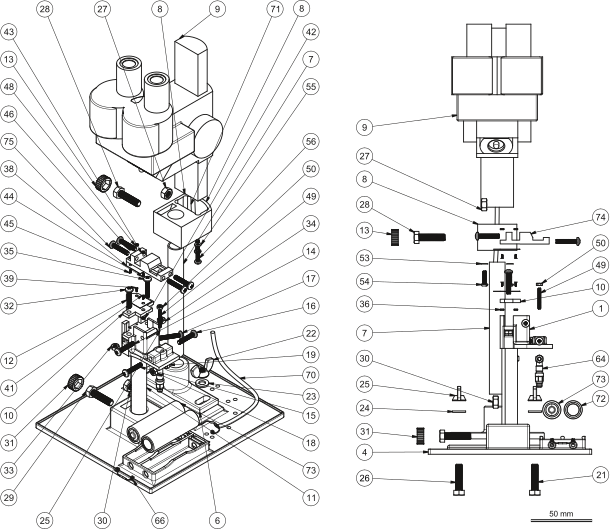
| Item | Part Number | Type | Item | Part Number | Type | |
|---|---|---|---|---|---|---|
| 1 | Main body | printed | 36 | M1 hex nut | generic | |
| 4 | Base plate | printed | 37 | M1 bolt 6mm | generic | |
| 6 | Miscroscope flange | printed | 38 | Upper tip element | custom | |
| 7 | Microscope rod 100 mm | generic | 39 | M1 bolt 6mm | generic | |
| 8 | Microscope slider | printed | 40 | M1 hex nut | generic | |
| 9 | Microscope | proprietary | 41 | M1 bolt 6mm | generic | |
| 10 | Lower tip element holder | printed | 42 | M1 hex nut | generic | |
| 11 | Main rod 90 mm | generic | 43 | M1 hex nut | generic | |
| 12 | Lower tip element | custom | 44 | M1 bolt 6mm | generic | |
| 13 | M5 knob | printed | 45 | M1 bolt 6mm | generic | |
| 14 | M3 bolt 16 mm | generic | 46 | M1 hex nut | generic | |
| 15 | M3 bolt 16 mm | generic | 47 | M1 bolt 6mm | generic | |
| 16 | M3 bolt 16 mm | generic | 48 | M1 hex nut | generic | |
| 17 | M3 bolt 16 mm | generic | 49 | M2 threaded rod 16 mm | generic | |
| 18 | M3 hex nut | generic | 50 | M2 hex nut | generic | |
| 19 | M3 hex nut | generic | 51 | M2 bolt (from microscope) | generic | |
| 20 | M3 hex nut | generic | 52 | M2 washer (from microscope) | generic | |
| 21 | M5 hex bolt | generic | 53 | M2 washer (from microscope) | generic | |
| 22 | M5 wing nut | generic | 54 | M2 bolt (from microscope) | generic | |
| 23 | M5 washer | generic | 55 | M2 washer (from microscope) | generic | |
| 24 | M5 washer | generic | 56 | M2 bolt (from microscope) | generic | |
| 25 | M5 wing nut | generic | 64 | KISTLER 9215A | proprietary | |
| 26 | M5 hex bolt | generic | 65 | Kistler 1651C | proprietary | |
| 27 | M5 hex nut | generic | 66 | Battery connection wire | generic | |
| 28 | M5 hex bolt | generic | 70 | Cable batteries to microscope | generic | |
| 29 | M5 hex bolt | generic | 71 | Cable mircoscope | generic | |
| 30 | M5 hex nut | generic | 72 | AA battery | generic | |
| 31 | M5 knob | printed | 73 | AA battery | generic | |
| 32 | M3 bolt 16 mm | generic | 74 | Lever | printed | |
| 33 | M3 hex nut | generic | 75 | M3 bolt 16 mm | generic | |
| 34 | M3 hex nut | generic | 76 | M3 bolt 16 mm | generic | |
| 35 | M3 bolt 16 mm | generic | 77 | M3 bolt 16 mm | generic |
Projected views (all directions)
VIII. Schematics of tip elements and exemplary edge shapes
IX. Additional diagrams and photos
Charge amplifier for piezo-electric force transducer
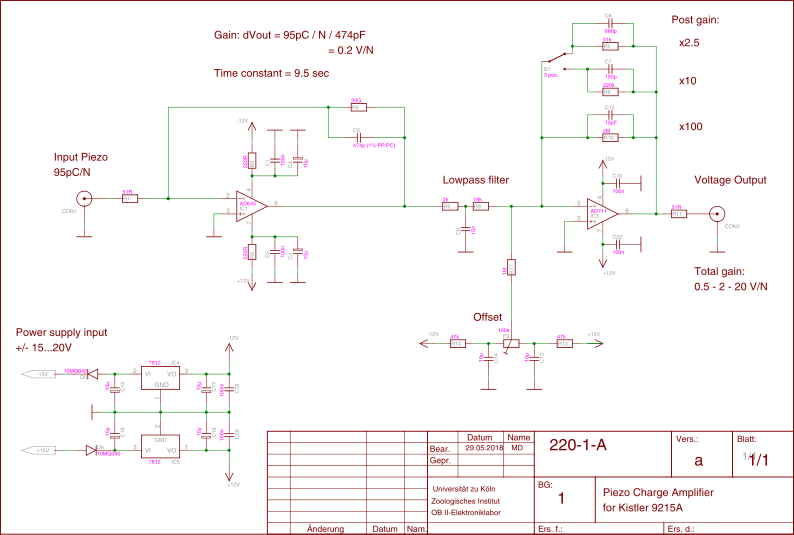

The plus pole thread of the 2-threaded wire coming from the BNC output of the amplifier is attached to the LabJack with the screw at AIN0, and the negative pole wire at the GND screw. Make sure the wires don't touch each other to prevent a short circuit.
Power source

Full setup

References ====================
- Herrel, A., Spithoven, L., van Damme, R., & de Vree, F. (1999). Sexual dimorphism of head size in Gallotia galloti: Testing the niche divergence hypothesis by functional analyses. Functional Ecology, 13(3), 289–297. https://doi.org/10.1046/j.1365-2435.1999.00305.x
- R Core Team. (2021). R: A language and environment for statistical computing. R Foundation for Statistical Computing. R Foundation for Statistical Computing. http://www.R-project.org