Você está no 3DFinder
Buscamos em Thingiverse, MakerWorld e Printables ao mesmo tempo para te dar o melhor de cada uma.
Descrição
15/12/2025 - ONLINE LESSONS are available now for LSC-PRINT&PLAY and for all forms of the Lindsay System. Learn from the originator Donald WG Lindsay, with 12 years of playing experience (the longest possible on this chanter!) and credits on the Lindsay System including film scores, critically acclaimed albums (5 stars BBC Music Mag, 4 stars Songlines), and live appearances at Celtic Connections, Sidmouth Folk Festival, and more. A solid syllabus has been developed for new learners, with the book expected in late 2026.
https://lindstruments.com/products/one-to-one-lessons
*** Keep posting your MAKES, as this MAKES us happy :) To date (end June 2025) we've had 2,547 downloads. We are very much enjoying seeing and hearing your chanters over on the FB groups "3D Bagpipe & Whistle Builders", "Playing Smallpipes", "Lindsay System Chanter", and "LBPS Forum". New makers, log on and join in the fun!
PLEASE NOTE : When purchasing reeds for the LSC_PRINT&PLAY, particularly from recommended makers, please remember that every print of this chanter will differ very slightly in microscopic ways to every other print. 3D printing is not yet at the stage where results have perfect consistency, and this is particularly true of home printing using FDM/FFF style (RepRap-derived) printers. We will not be there for some time yet, so in the meantime DO NOT blame the reed or the reed maker or we may exhaust the patience of reed makers to make for this chanter (which, would be bad for everyone). Our reed makers recommended here are experts, making a tiny something which approximates to a miniature violin body in its fiddlyness and is an instrument in its own right. Don't alter your reed, other than the wire bridle (for proper guidance on this, see Richard Evans video here - https://www.youtube.com/watch?v=hlIB3zqdDuc).
With all that said, the most recommended reed for this chanter is now Iain Allen's standard design for the "full spec" Lindsay System, which for the LSC_PRINT&PLAY should be run in a chanter with the short top section (file LSCPnP_TopShort).
Many of those who have printed the LSC_RPINT&PLAY on a well set up and calibrated printer have been delighted with the tuning, however if the tuning is imperfect, then (a) don't be surprised and (b) use the traditional methods which are to place a turn of electrical tape around the chanter immediately above the offending hole, covering a little of the top edge until the note is flattened into tune, or if one note is consistently flat then you might consider filing a little away from the top edge of the hole to sharpen it into tune (hence why we always recommend printing the chanter at 100% infill). Worst case scenario, print another chanter - better and in most circumstances quicker and cheaper than destroying a reed. Print a few more, give them to friends!
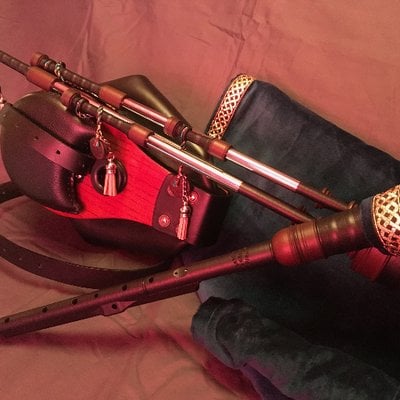
The LSC_PRINT&PLAY is the result of an intensive remote collaboration during early 2020, between Z.QIAO Bagpipes of London, and Lindstruments of Ascension Island, South Atlantic. The design requires no hand finishing, making innovative use of flat surfaces and square internal bores to ensure that the chanter will print ready-to-play, requiring only the addition of a cane “A” Scottish smallpipes reed, and of course a set of pipes to play it in.
Reedmakers we recommend are Dave Shaw, Iain Allen, Chris Apps, and a reed suitable for a McCallum small pipe in “A” is the ideal for this chanter. Iain Allen in particular has a specialised design for the “full spec” Lindsay system (which has a greater range and more semitones). To use that reed, you should print the short top LSCPnP_TopShort (see below). Also suitable are reeds intended for the McCallum's/Morrison A smallpipes, for which you should print the long top LSCPnP_TopLong.
Files are provided for users who play with their right hand lowest, and also for those who play with the left hand lowest. Players using the left hand as their bottom hand should use the files titled "LHBody...".
Three body types have been provided, and three top section types as follows :
LSCPnP_BodyStandard.stl / LSCPnP_LHBodyStandard.stl : This is the body design which was used to record the "LSC_PRINT&PLAY" video for YouTube. It is the most thoroughly tested design.
LSCPnP_BodyHalf.stl / LSCPnP_LHBodyHalf.stl : For this design, the lower edges of the fingerholes have been redrawn as a mirror image of the upper edges.
LSCPnP_BodyDiamond.stl / LSCPnP_LHBodyDiamond.stl : For this design, the internal bore (which is square-section) has been rotated 45 degrees. The fingerholes are of the same design as for the ...BodyHalf... files. This creates a gradual under and overcoat on each hole. The "diamond" bore is 45 degrees offset from the square bore in the top section files, but this doesn't seem to cause any issues.
Top Section Files :
LSCPnP_TopLong : The long top section is the first to try if you intend to use an existing reed that you have, and is the top that was used for the chanter played in the "LSC_PRINT&PLAY" video - in that case it was running a Shaw reed, patterned for a McCallums/Morrison style chanter.
LSCPnP_TopMedium : The medium top is provided to allow for experimentation with different reeds, and with adjusting reeds, and should be used if the long top proves too flat but the short too sharp.
LSCPnP_TopShort : The short top would suit reeds to the pattern used for the "full spec" Lindsay System chanter, such as those made by Iain Allen.
Three "Cap" files have also been provided. The LSC_PRINT&PLAY will perform best when the reed is contained within a specially designed & enclosed split stock pieced. The three "Cap" files provided here all have the same non-cylindrical internal design. Users who have a set of smallpipes with a "split stock" system already installed should select the part to print that will best fit their set. A cap with a 19mm tenon, and one with a 24mm tenon, have been provided. Other sizes will be added if needed, so drop us a message if neither of these sizes is suitable for your pipes. The "...CapLong24mm" file is designed to allow the length of the stock to be contained internally within the receiving stock, making it suitable for e.g. John Walsh pipes that use a system like this.
A receiving stock has also been included, LSCPnP_BagStock. This receiving stock is sized to be easily installed into a Canmore or Bannatyne hybrid bag, and has grooves to allow two o-rings to be used instead of only one. This makes installation using the provided jubilee clip somewhat easier, and the double groove is also good for wrapping with sinew etc.
Currently no files are available to add drones or blowpipe/bellows pipe, however these are expected to be provided in due course.