Você está no 3DFinder
Buscamos em Thingiverse, MakerWorld e Printables ao mesmo tempo para te dar o melhor de cada uma.
Descrição
简介
万花尺 也叫繁花曲线规,是一种绘图玩具,由外图板及内圆图板两部分组成。内圆图板像一个齿轮,沿圆心不同半径的位置带有许多笔洞,外图板为一类似为内齿轮的大型圆孔,内圆板放在外图板的圆洞中,循着圆周转动,以铅笔或圆珠笔从笔洞可以画出像花朵一样规则图案。有些万花尺会配有几个不同半径的内圆图板。

万花尺所画出的图案,与外图板圆圈半径、内圆图板半径及笔洞位置有相关性。图案令人联想到万花筒,故名万花尺。
从数学(尤其是解析几何)观点观察,内圆板放在外图板的圆洞中,循着圆周转动所画出的图案是内旋轮线;两个内圆板互贴,固定其中一个内圆板,让另一个可活动内圆板沿着固定内圆板转动所画出的图案是外旋轮线;外图板为长方形之内挖出大圆孔,如果外图板的长方形外框上具有齿轮(一般没有,只有刻度供儿童当直尺使用)的话,内圆板沿着长方形外框转动所画出的图案是短摆线。
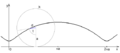
短摆线,内圆板沿着长方形外框转动所画出的图案
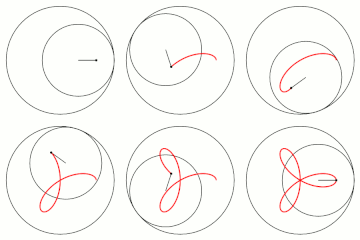
内旋轮线,万花尺最常见的用法
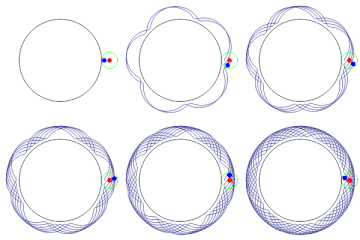
外旋轮线,可活动内圆板沿着固定内圆板转动所画出的图案


brief introduction
The Wanhua ruler, also known as the Fanhua curve gauge, is a type of drawing toy consisting of an outer drawing board and an inner circular drawing board. The inner drawing board is like a gear, with many pen holes at different radii along the center of the circle. The outer drawing board is a large circular hole similar to the inner gear, and the inner drawing board is placed in the circular hole of the outer drawing board. It rotates along the circumference and can be drawn with a pencil or ballpoint pen from the pen hole to draw a regular pattern like a flower. Some calipers are equipped with several inner circle drawing boards of different radii.
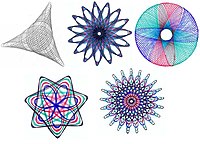
The pattern drawn by the ruler is related to the radius of the outer circle, the radius of the inner circle, and the position of the pen hole. The pattern is reminiscent of a kaleidoscope, hence the name Wanhuachi.
From a mathematical (especially analytical geometry) perspective, the pattern drawn by placing the inner circular plate in the circular hole of the outer drawing plate and rotating it along the circumference is an inner spiral line; Two inner circular plates are attached to each other, one of which is fixed, and the other movable inner circular plate rotates along the fixed inner circular plate. The pattern drawn is an outer spiral wheel line; The outer drawing board is a rectangle with a large circular hole dug out inside. If there are gears on the rectangular outer frame of the outer drawing board (usually not available, only scales are used by children as rulers), the pattern drawn by the inner drawing board rotating along the rectangular outer frame is a short cycloid.
A short cycloid is a pattern drawn by rotating an inner circular plate along the outer frame of a rectangle
The most common use of a compass is the inner spiral line
The pattern drawn by rotating the movable inner circular plate along a fixed inner circular plate with an outer spiral wheel line
Mathematical basis
Consider a fixed outer circle 𝐶𝑜 of radius 𝑅
centered at the origin. A smaller inner circle 𝐶𝑖
of radius 𝑟<𝑅
is rolling inside 𝐶𝑜
and is continuously tangent to it. 𝐶𝑖
will be assumed never to slip on 𝐶𝑜
(in a real Spirograph, teeth on both circles prevent such slippage). Now assume that a point 𝐴
lying somewhere inside 𝐶𝑖
is located a distance 𝜌<𝑟
from 𝐶𝑖
's center. This point 𝐴
corresponds to the pen-hole in the inner disk of a real Spirograph. Without loss of generality it can be assumed that at the initial moment the point 𝐴
was on the 𝑋
axis. In order to find the trajectory created by a Spirograph, follow point 𝐴
as the inner circle is set in motion.
Now mark two points 𝑇 on 𝐶𝑜
and 𝐵
on 𝐶𝑖
. The point 𝑇
always indicates the location where the two circles are tangent. Point 𝐵
, however, will travel on 𝐶𝑖
, and its initial location coincides with 𝑇
. After setting 𝐶𝑖
in motion counterclockwise around 𝐶𝑜
, 𝐶𝑖
has a clockwise rotation with respect to its center. The distance that point 𝐵
traverses on 𝐶𝑖
is the same as that traversed by the tangent point 𝑇
on 𝐶𝑜
, due to the absence of slipping.
Now define the new (relative) system of coordinates (𝑋′,𝑌′) with its origin at the center of 𝐶𝑖
and its axes parallel to 𝑋
and 𝑌
. Let the parameter 𝑡
be the angle by which the tangent point 𝑇
rotates on 𝐶𝑜
, and 𝑡′
be the angle by which 𝐶𝑖
rotates (i.e. by which 𝐵
travels) in the relative system of coordinates. Because there is no slipping, the distances traveled by 𝐵
and 𝑇
along their respective circles must be the same, therefore
𝑡𝑅=(𝑡−𝑡′)𝑟,
or equivalently,
𝑡′=−𝑅−𝑟𝑟𝑡.
It is common to assume that a counterclockwise motion corresponds to a positive change of angle and a clockwise one to a negative change of angle. A minus sign in the above formula (𝑡′<0) accommodates this convention.
Let (𝑥𝑐,𝑦𝑐) be the coordinates of the center of 𝐶𝑖
in the absolute system of coordinates. Then 𝑅−𝑟
represents the radius of the trajectory of the center of 𝐶𝑖
, which (again in the absolute system) undergoes circular motion thus:
𝑥𝑐=(𝑅−𝑟)cos𝑡,𝑦𝑐=(𝑅−𝑟)sin𝑡.
As defined above, 𝑡′ is the angle of rotation in the new relative system. Because point 𝐴
obeys the usual law of circular motion, its coordinates in the new relative coordinate system (𝑥′,𝑦′)
are
𝑥′=𝜌cos𝑡′,𝑦′=𝜌sin𝑡′.
In order to obtain the trajectory of 𝐴 in the absolute (old) system of coordinates, add these two motions:
𝑥=𝑥𝑐+𝑥′=(𝑅−𝑟)cos𝑡+𝜌cos𝑡′,𝑦=𝑦𝑐+𝑦′=(𝑅−𝑟)sin𝑡+𝜌sin𝑡′,
where 𝜌 is defined above.
Now, use the relation between 𝑡 and 𝑡′
as derived above to obtain equations describing the trajectory of point 𝐴
in terms of a single parameter 𝑡
:
𝑥=𝑥𝑐+𝑥′=(𝑅−𝑟)cos𝑡+𝜌cos𝑅−𝑟𝑟𝑡,𝑦=𝑦𝑐+𝑦′=(𝑅−𝑟)sin𝑡−𝜌sin𝑅−𝑟𝑟𝑡
(using the fact that function sin is odd).
It is convenient to represent the equation above in terms of the radius 𝑅 of 𝐶𝑜
and dimensionless parameters describing the structure of the Spirograph. Namely, let
𝑙=𝜌𝑟
and
𝑘=𝑟𝑅.
The parameter 0≤𝑙≤1 represents how far the point 𝐴
is located from the center of 𝐶𝑖
. At the same time, 0≤𝑘≤1
represents how big the inner circle 𝐶𝑖
is with respect to the outer one 𝐶𝑜
.
It is now observed that
𝜌𝑅=𝑙𝑘,
and therefore the trajectory equations take the form
𝑥(𝑡)=𝑅[(1−𝑘)cos𝑡+𝑙𝑘cos1−𝑘𝑘𝑡],𝑦(𝑡)=𝑅[(1−𝑘)sin𝑡−𝑙𝑘sin1−𝑘𝑘𝑡].
Parameter 𝑅 is a scaling parameter and does not affect the structure of the Spirograph. Different values of 𝑅
would yield similar Spirograph drawings.
The two extreme cases 𝑘=0 and 𝑘=1
result in degenerate trajectories of the Spirograph. In the first extreme case, when 𝑘=0
, we have a simple circle of radius 𝑅
, corresponding to the case where 𝐶𝑖
has been shrunk into a point. (Division by 𝑘=0
in the formula is not a problem, since both sin
and cos
are bounded functions.)
The other extreme case 𝑘=1 corresponds to the inner circle 𝐶𝑖
's radius 𝑟
matching the radius 𝑅
of the outer circle 𝐶𝑜
, i.e. 𝑟=𝑅
. In this case the trajectory is a single point. Intuitively, 𝐶𝑖
is too large to roll inside the same-sized 𝐶𝑜
without slipping.
If 𝑙=1, then the point 𝐴
is on the circumference of 𝐶𝑖
. In this case the trajectories are called hypocycloids and the equations above reduce to those for a hypocycloid.
描述引用自维基百科:万花尺 - 维基百科,自由的百科全书 (wikipedia.org)
Description cited from Wikipedia:Spirograph - Wikipedia