Você está no 3DFinder
Buscamos em Thingiverse, MakerWorld e Printables ao mesmo tempo para te dar o melhor de cada uma.
Descrição
My Educational Mechanical Examples Series
This model is one of my educational mechanical mechanism examples on 80mm x 80mm base plates.
You can find all models of the series in this collection => [Mechanical Mechanism Examples]
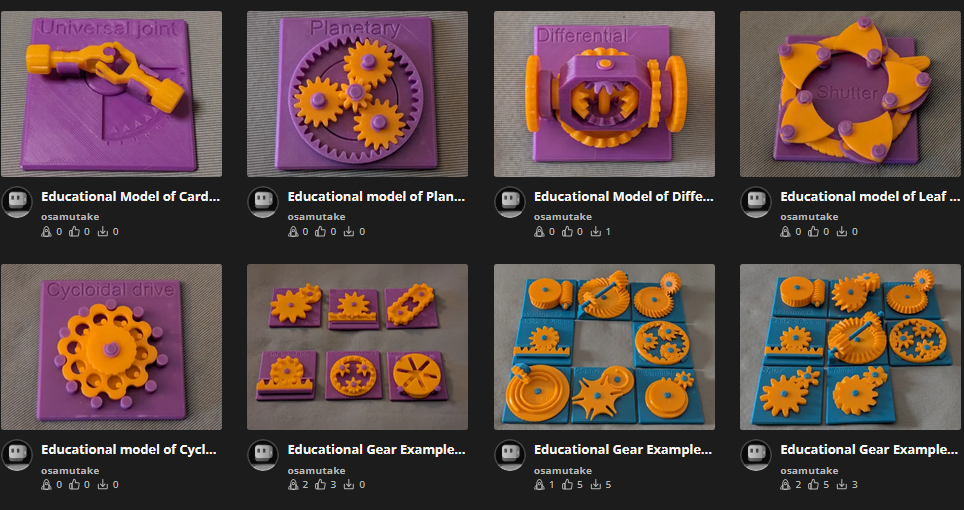
The present model
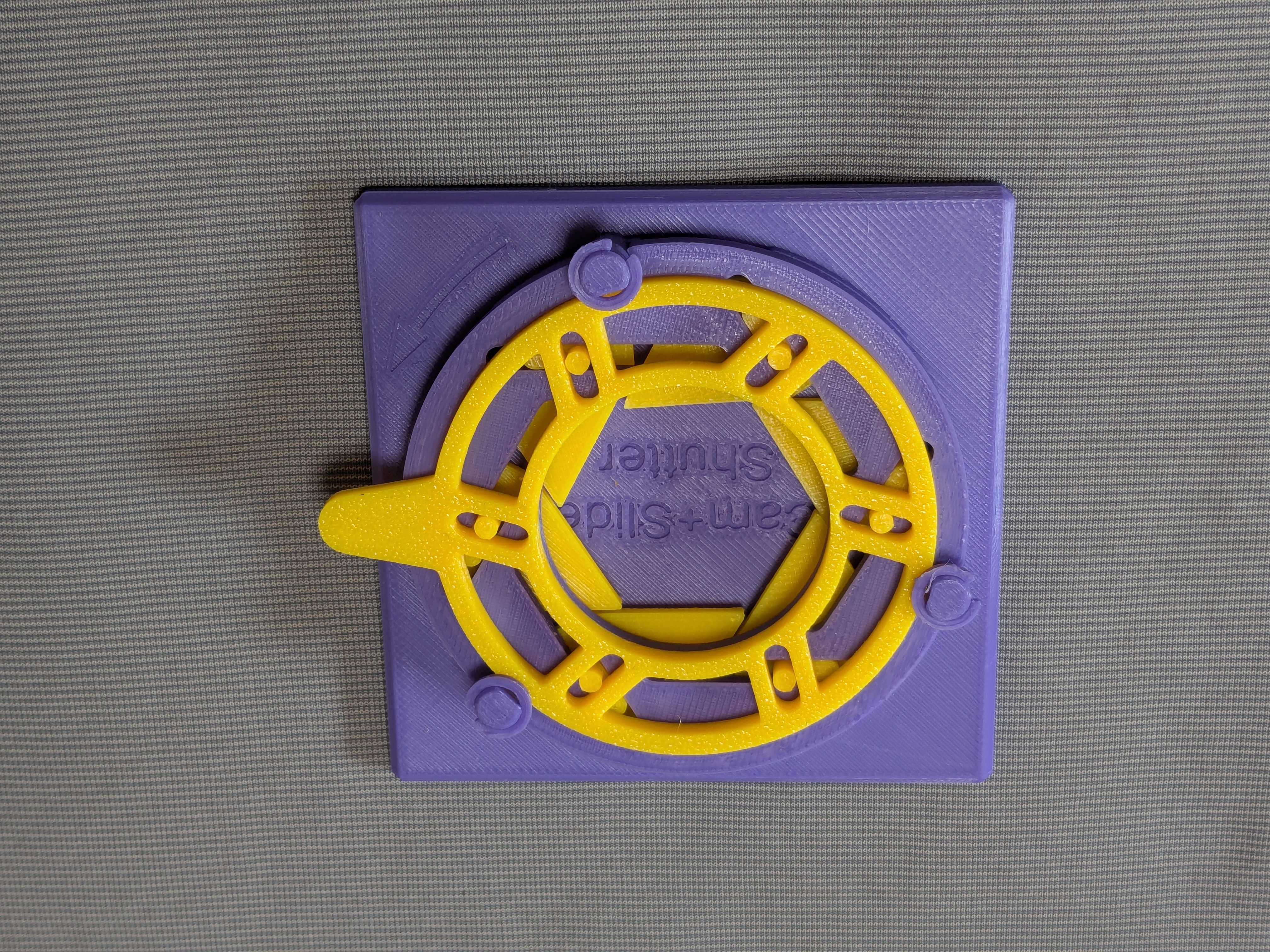
This is an educational models of a shutter whose leaves are moved by sliders and cams.
Brief Description
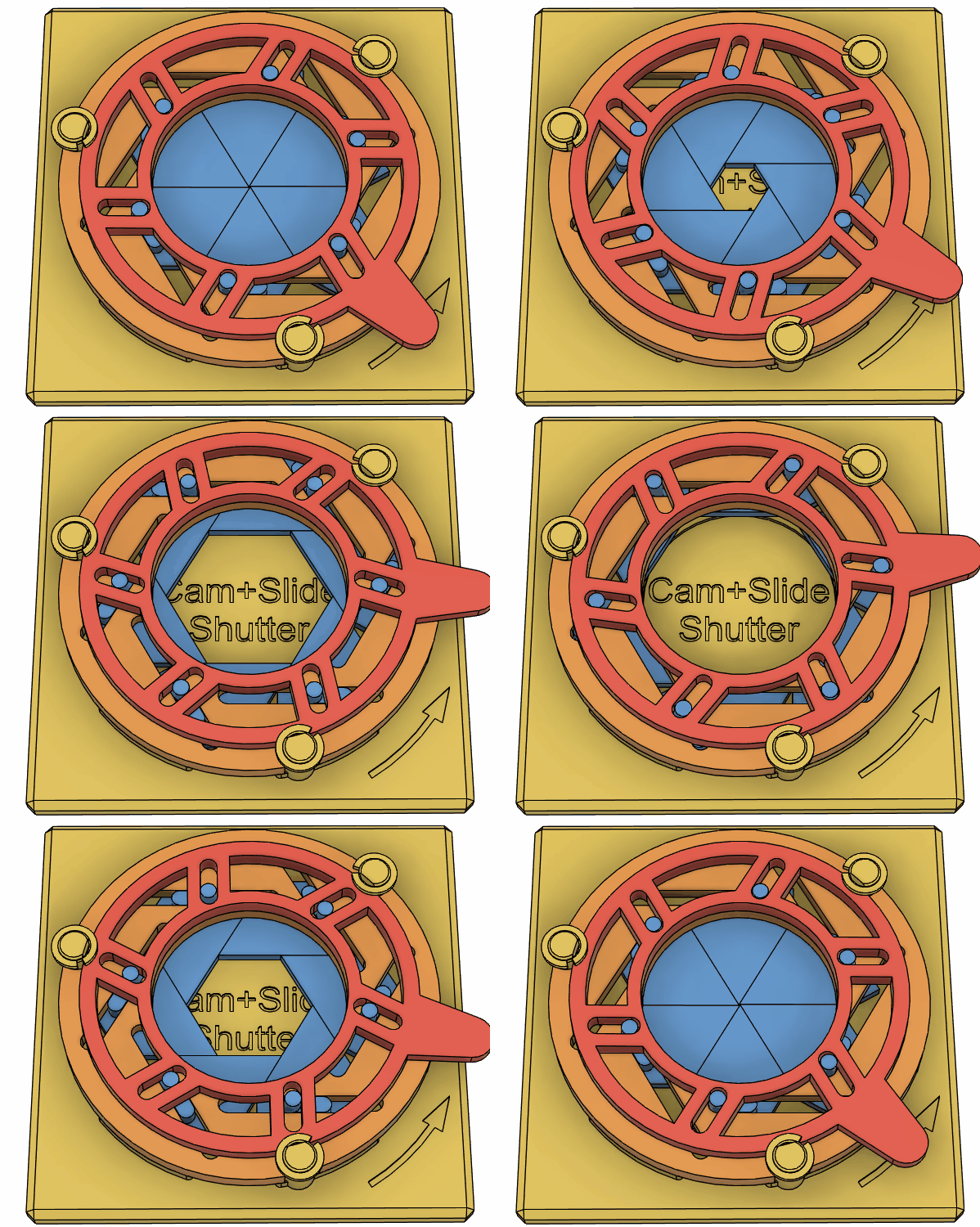
This shutter mechanism has six blades, all of which are driven simultaneously by a rotating input ring. As the blades slide in unison, the aperture opening changes in size while maintaining a regular hexagonal shape.
Each blade is mounted so that it can slide along its own dedicated guide rail. To receive motion from the input ring, each blade carries a pin that travels within a corresponding slot machined into the face of the input ring. As the ring rotates, the geometry of the slot converts the rotational motion into linear sliding motion of each blade. This arrangement can be regarded as a face-grooved cam mechanism — specifically, a variant where the cam groove is cut into the face of a rotating disk, and the follower (pin) is constrained to move in a linear path by the guide rail.
Related Models
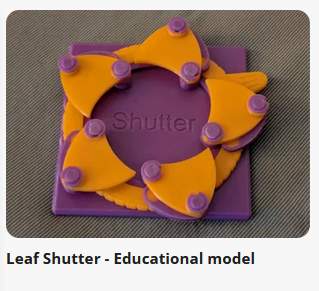
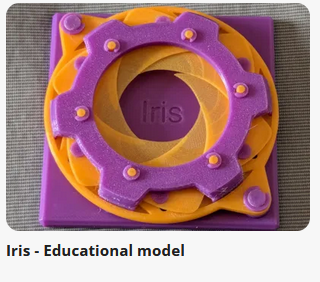


Case
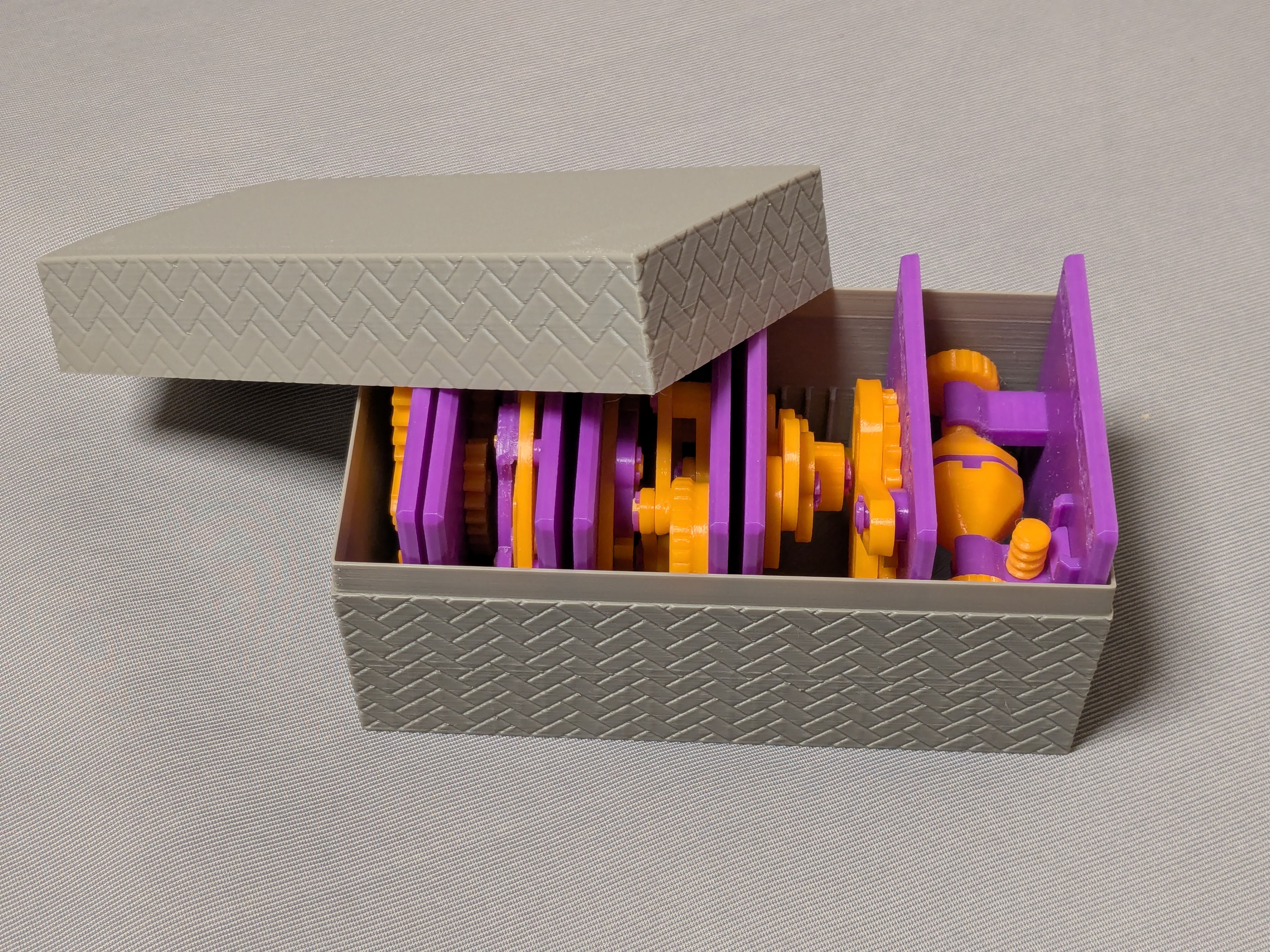
This model is compatible with the case included in my first set.
Printing
- Use the models named ???-printable.stl for printing.
The models named ???-assembled.stl are provided just to show how they should be assembled.
- Use well-dried PETG to have better dimensional accuracy.
- Use 0.1 mm or 0.08 mm layer height to have smoother surfaces.
- Use slow printing speed for overhangs.
- Select “Random” seam position to have smoother rotation.
Randomly distributed seam should be easily worn out after some wearing.Printing
Sanding and Filing
Note that, in this model, the rotation of the bases for bearings is intentionally made not too smooth.
Sometimes, the gears suffer from the stringing effect and/or elephant foot effect, resulting in a too tight fit to the shafts (they are designed with a 0.15 mm radial clearance).
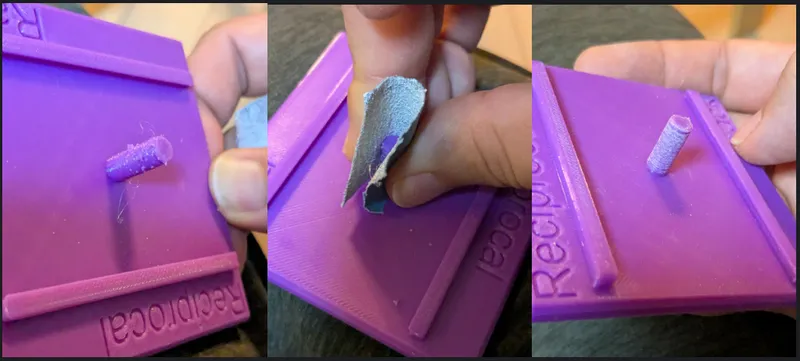
If you see rough surface on the shafts due to stringing, sand off the roughness with a small piece of sand paper.
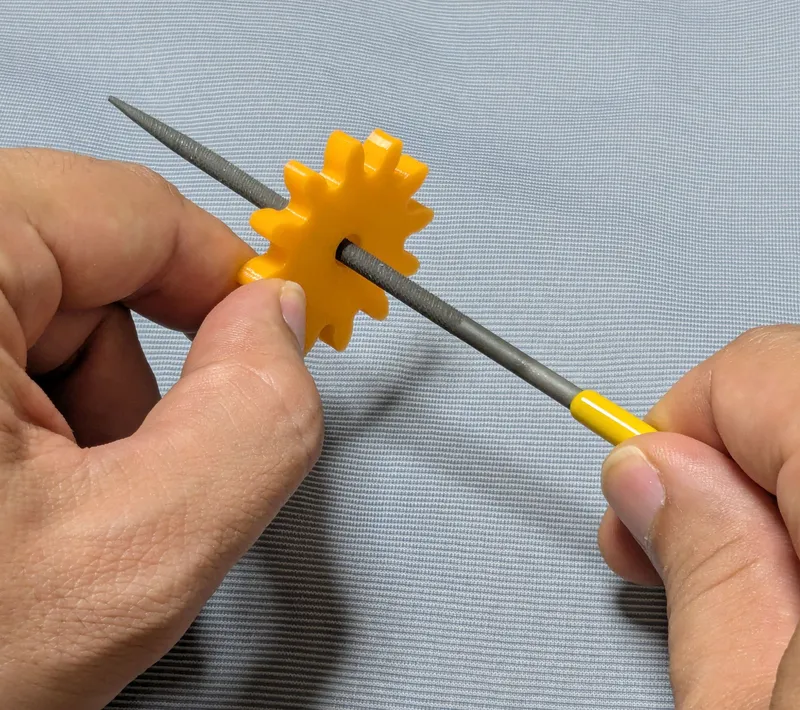
If you feel the gears do not rotate smoothly due to an elephant effect, widen the hole slightly by using a thin round bar file.
Without those issues, the parts should rotate very smoothly with minimal friction.
Assembly
Put them in the right places and secure the input ring by the retaining rings.
Other examples
You may also be interested in the models in my educational mechanical mechanism examples.
Find them in this collection:
[https://makerworld.com/collections/15048577-my-educational-mechanism-models](https://makerworld.com/collections/15048577-my-educational-mechanism-models)
Happy printing!
Acknowledgement
I got into gears thanks to K.$uzuki's amazing articles and YouTube videos. Many of the mechanisms shown in this series came from the introductions on his website. He also makes excellent gear models himself. This series wouldn’t have existed without his inspiration.
I learned a lot about technical detail of designing gear tooth profiles from Haguruma-No-Hanashi website. I’m truly grateful for that.
License (2026-03-13 updated)
- The 3D model(s) are licensed under Creative Commons Attribution 4.0 International. (unchanged)
- However, the text and images on this page are copyright reserved. (added on 2026-03-13)
Cam-Slide Shutter - Educational Model

Publicado em 1 de abr de 2026
Gostou deste modelo? Crie uma conta grátis para salvar seus favoritos e voltar a eles depois.
Criar conta