Você está no 3DFinder
Buscamos em Thingiverse, MakerWorld e Printables ao mesmo tempo para te dar o melhor de cada uma.
Descrição
Notice
If you've been following my work, you know I don't usually drop everything at once - and this release is no different. The launch will be phased over the coming days, so stay tuned as new content becomes available.
I'm starting with the friction-fit modules, the simplest and most accessible entry point into the system. As indicated, three sizes are planned - both for these friction modules and for the sliding versions with bearing-based movement, which will be available shortly after.
What It Is
This project grew directly out of the 5 Grams Cable Clip. Once that system was done, a matching drawer module felt like the natural next step. The challenge wasn't building drawers. The challenge was building drawers worth keeping…
Difficulty: Intermediate. Some assemblies require gluing insert pieces with attention to filament orientation. Print pauses are required for the soft-close damper insert and for multi-colour front panels. Refer to Bambu Studio's print pause guide for details.
What It Does
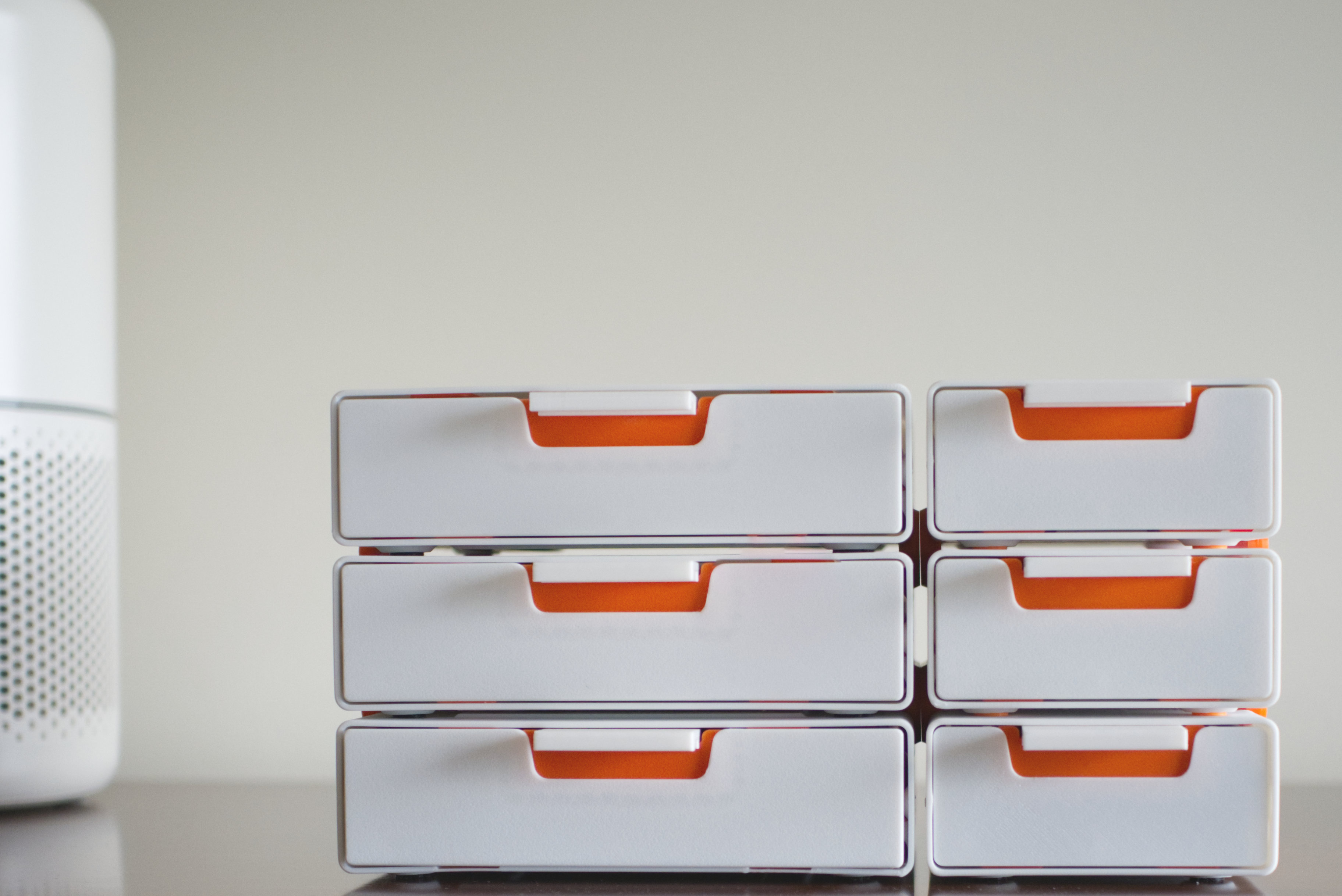
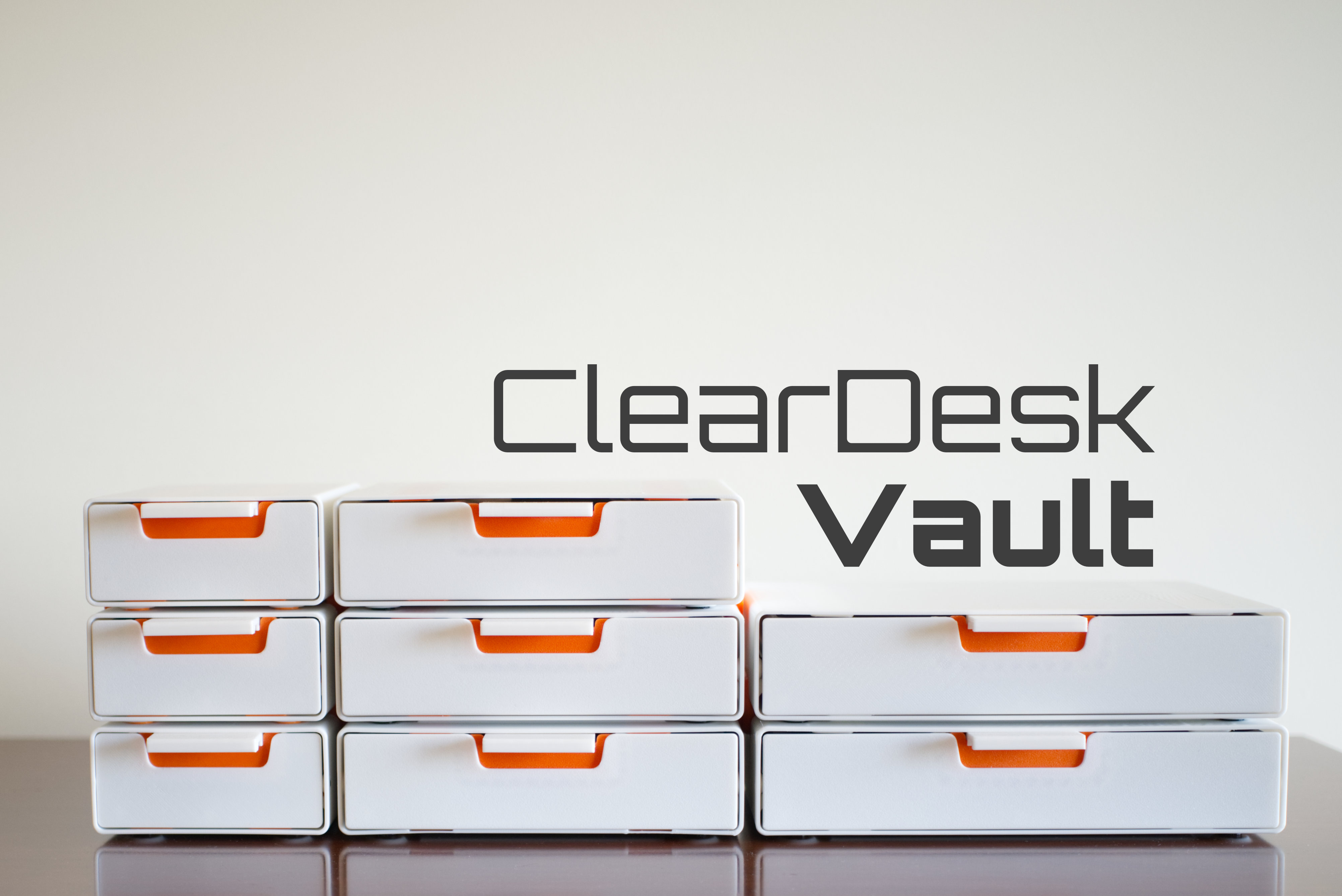
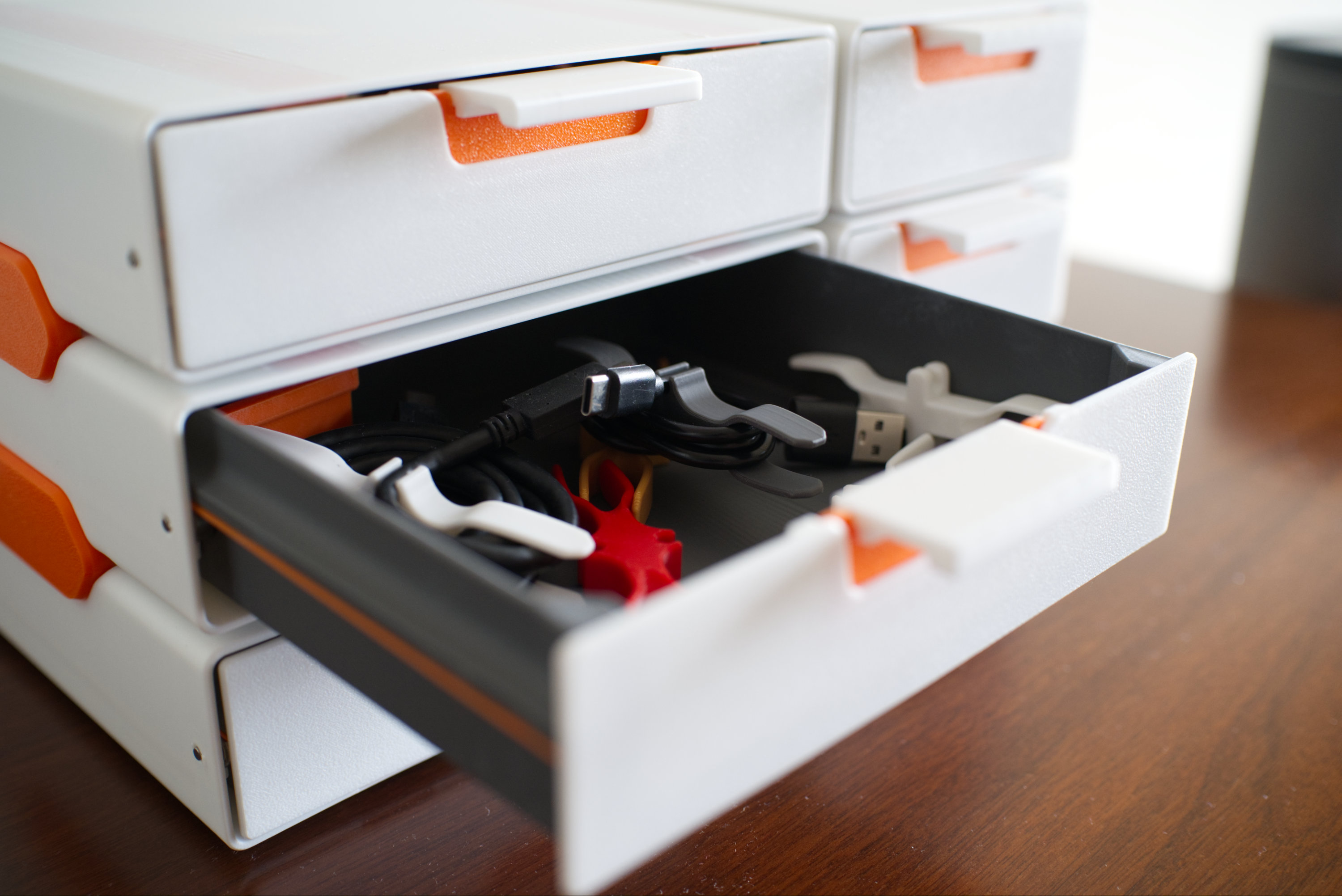
ClearDesk Vault provides stackable, modular desktop drawer storage in three sizes (Larger - 255x175x60 | Medium- 200x175x60 | Narrower- 110x175x60), with a strong focus on smooth, quiet operation and a polished visual finish. Drawers sit on your desk surface and can be stacked in any quantity, with a minimum of two, locked together with a dedicated stacking piece.
How It Works
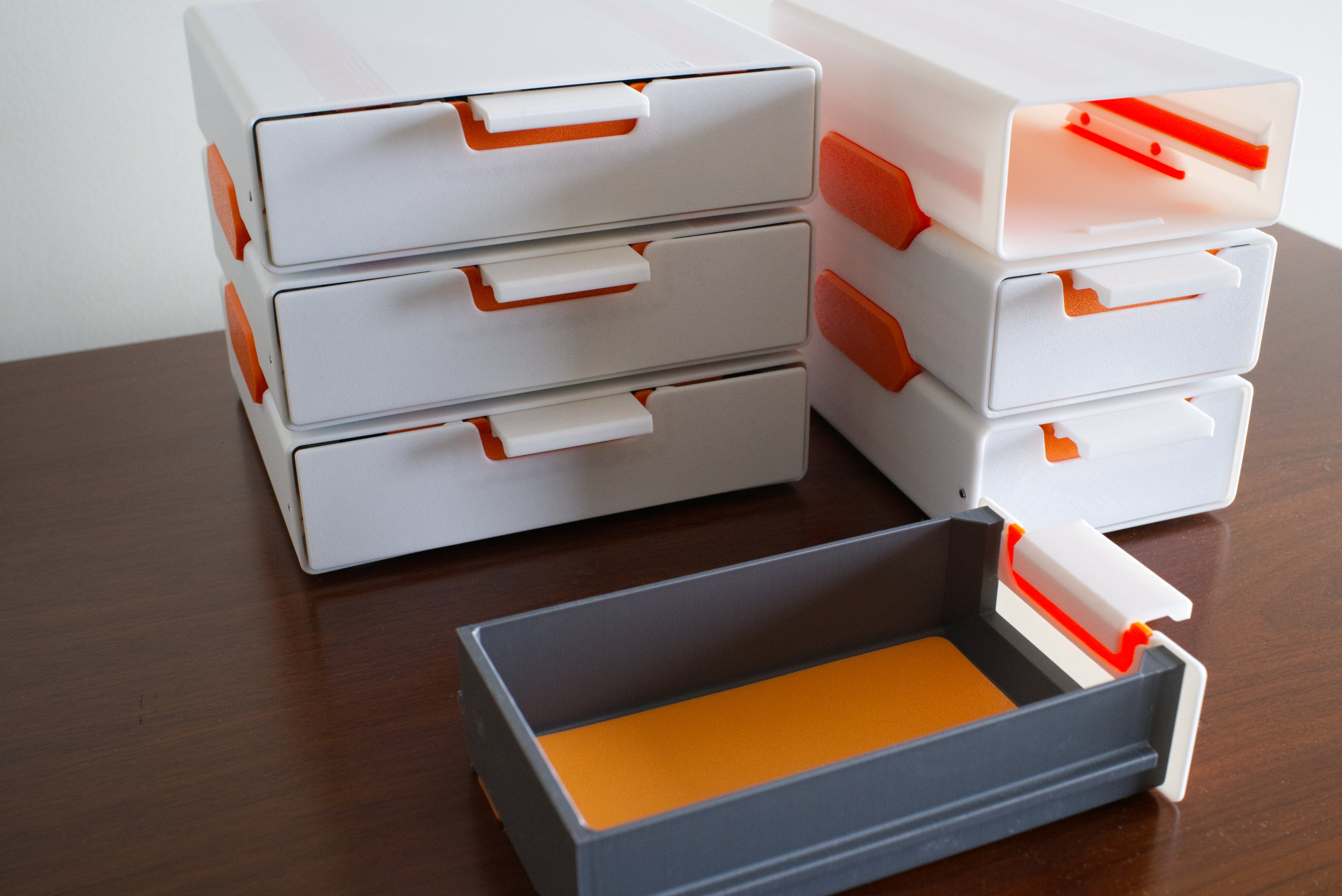
Each module consists of a main body, a drawer with a customisable front panel, and a locking stacking piece that secures units vertically. Two guide systems are available:
- Sliding guides — carefully iterated to minimise the plastic-on-plastic friction noise typical of printed parts. A passive retention mechanism prevents the drawer from sliding open on its own.
- Ball bearing guides — significantly smoother and lighter action, using widely available and inexpensive bearings (listed in BOM). Steel dowel pins are used as axles, which is the only sensible choice when working with bearings.
Soft-Close Damper Insert
During printing, a pause is programmed at a specific layer to allow the placement of a small damper accessory that softens the drawer's closing action. This piece should be printed in TPU 85A or lower Shore hardness. The softer the material, the more effective the dampening.
Note on TPU hardness: At the time of writing, Bambu Lab does not offer a TPU below 85A. A third-party TPU with a Shore hardness of 80A or lower will produce noticeably better results for this specific component. The standard TPU 95A used elsewhere in the project is too firm for effective dampening here and is not recommended for this insert. Refer to Bambu Studio's print pause guide for layer pause setup.
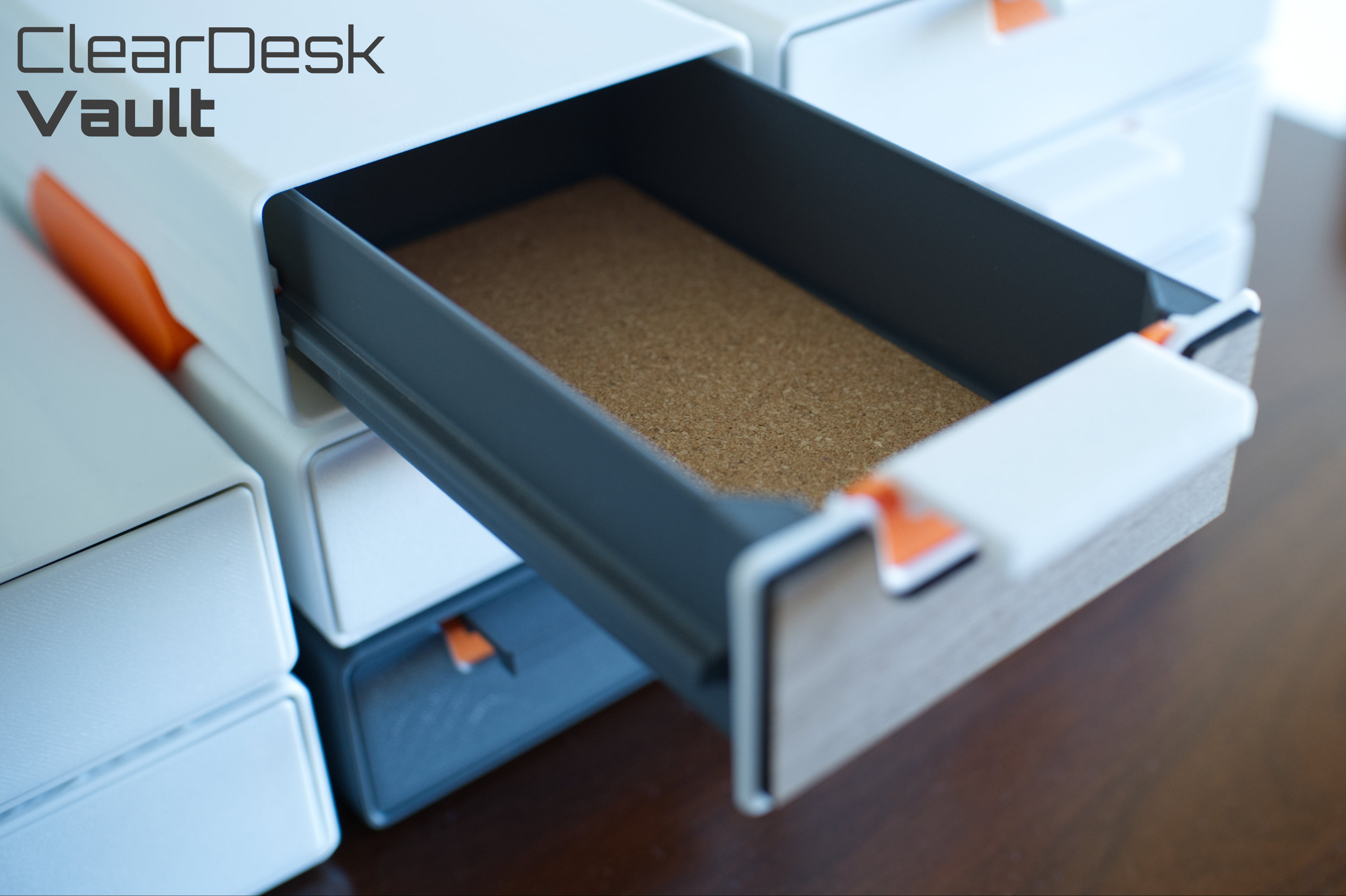
Drawer bottoms are lined with a 0.8 mm TPU film. For the best acoustic result, cork lining is strongly recommended. It dampens impact noise and gives the interior a premium feel, in the same way it did in the Nice Purge Bin. An optional internal grid tray can be placed directly on top of the cork or TPU; the organisation is left entirely to you.
Feet and drawer bumpers are also printed in TPU, providing grip and soft-close dampening at the rear of travel.
 |  |
Key Features
- Two guide variants: sliding (quiet, no hardware) and ball bearing (ultra-smooth, minimal effort)
- Three drawer sizes: small, medium, and large. Same height and depth across all sizes; width is what changes. Sizes are not multiples of each other
- Unlimited stacking with a dedicated locking piece. Gluing is recommended for permanent setups
- Soft-close damper insert, placed during a print pause, printed in TPU 85A or softer
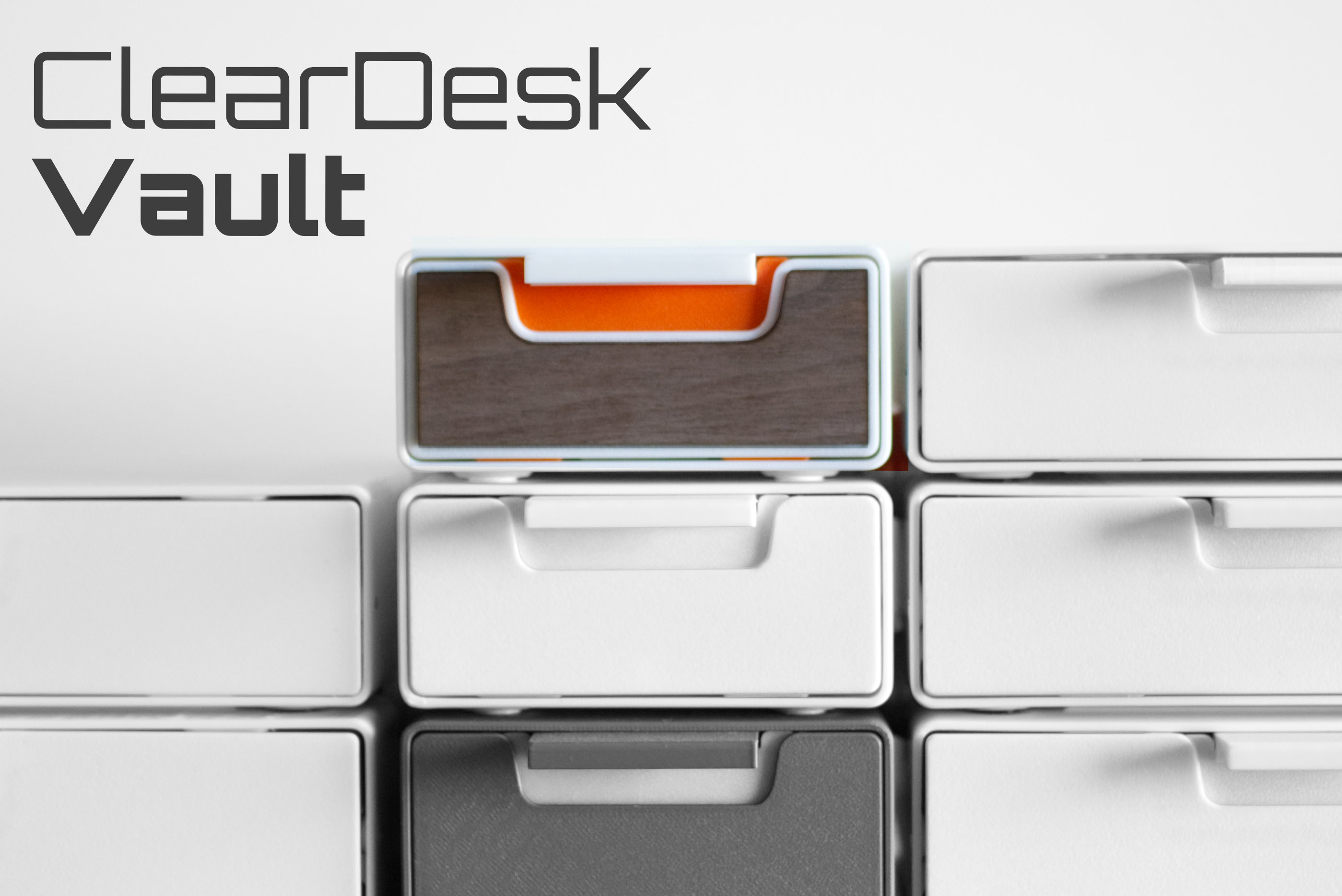
- Customisable front panels: colour-matched to the body with a contrasting accent element on the lock. Same handle geometry across all sizes
- Laser-cut front option: for printers with laser capability (e.g. Bambu H2 series), a front panel variant accepts wood, acrylic, or similar sheet material
- TPU feet and rear bumpers for grip and soft-close behaviour
- Cork or TPU interior lining for noise reduction and surface protection
- Passive drawer retention: drawers won't slide open on their own
- Insert pieces with controlled filament orientation, assembled with glue for consistent results across different setups
Configurations
Sliding Guide Variant
| Size | Front Panel Options |
|---|---|
| Small | Standard colour-match / Laser-cut insert |
| Medium | Standard colour-match / Laser-cut insert |
| Large | Standard colour-match / Laser-cut insert |
- No hardware required beyond glue and the TPU damper insert
- Insert pieces with oriented filament path to minimise guide noise
- Passive retention mechanism prevents unintended opening
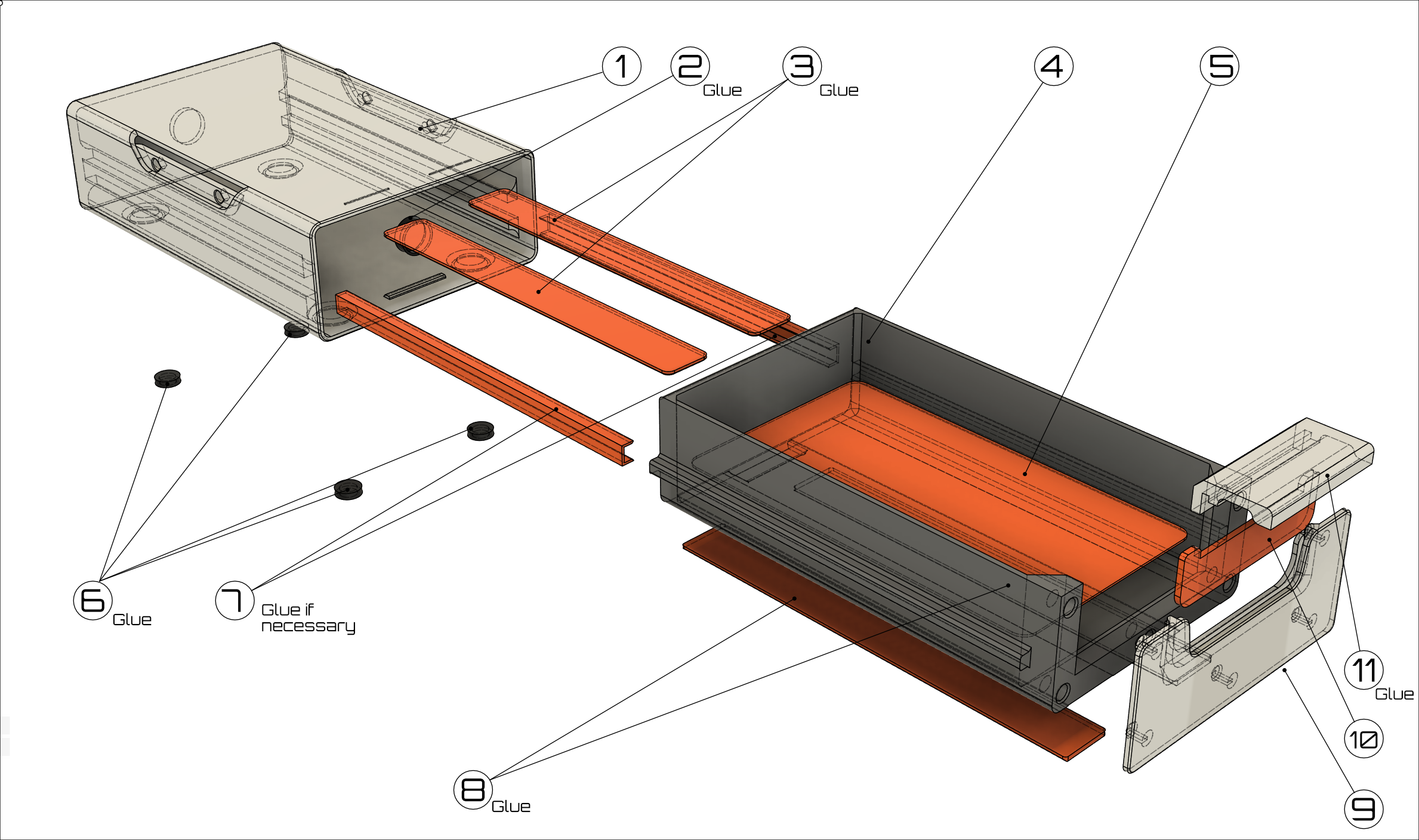
- 1 Outer Shell
- 2 Rear Damper
- 3 Upper Slide
- 4 Drawer
- 5 Anti-slip Matr
- 6 Foot
- 7 Side Rails
- 8 Lower Slide
- 9 Drawer Front
- 10 Handle Backplate
- 11 Handle
Ball Bearing Guide Variant
| Size | Front Panel Options |
|---|---|
| Small | Standard colour-match / Laser-cut insert |
| Medium | Standard colour-match / Laser-cut insert |
| Large | Standard colour-match / Laser-cut insert |
- Requires ball bearings (BOM) and steel dowel pins (external purchase)
- Smoother, lighter action with significantly less effort
- Recommended for users who prioritise feel over simplicity of assembly
Stacking: Any combination of sizes and variants can be stacked. Minimum two units. Locking piece included in all configurations. Gluing is recommended for permanent setups.
Print profiles: Available for Bambu Lab printers. Laser-cut front panel variant included in profiles for H2 series users.
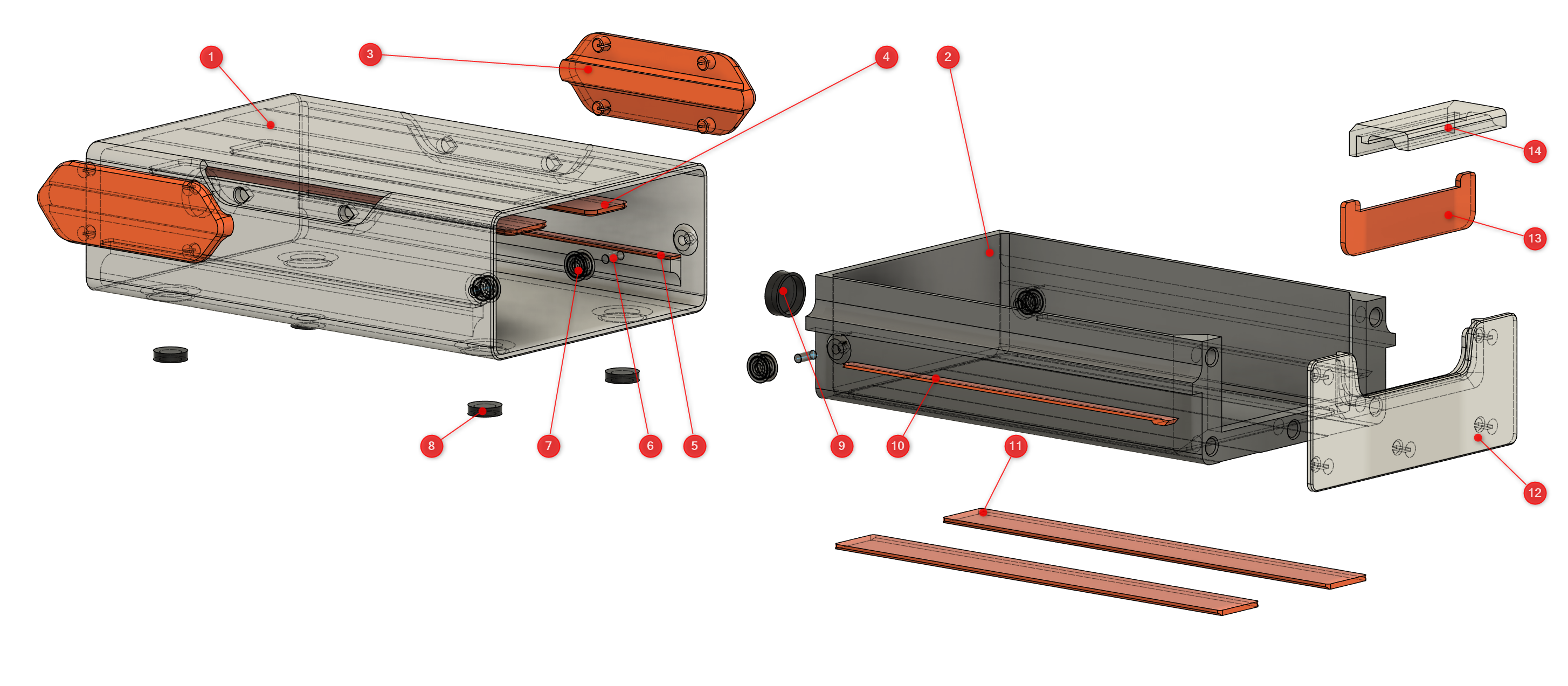
- 1 Outer Shell
- 2 Drawer
- 3 Lateral Clip
- 4 Upper Slide
- 5 Side Rails for the Outer Shell
- 6 4x 3x8 mm Stainless Steel Dowel Pins DA017
- 7 4x Ball Bearing 623ZZ (6PCS) - EA008
- 8 Feets
- 9 Rear Damper
- 10 Side Rails for the d«Drawer
- 11Lower Slide
- 12 Drawer Front
- 13 Handle Backplate
- 14 Handle
Materials Used
Print Materials
| Material | Application |
|---|---|
| PLA (standard) | Main body, drawer, front panels, structural parts |
| TPU 95A or 85A | Feet, rear bumpers, interior liner (0.8 mm) |
⚠️ TPU moisture warning: Even fresh-from-box TPU must be dried for a minimum of 12 hours before printing. Printing a single object at a time will not save you from stringing and poor surface quality if the filament is damp. This applies regardless of brand or Shore hardness.
Note on fibre-filled materials: Carbon-fibre and glass-fibre loaded filaments are significantly noisier in the guide system. Do not use them for any guide components. The reasons behind this, including how abrasive materials affect extrusion consistency and nozzle wear over time, are covered in Filament Flow Calibration: The Key to Dimensional Accuracy in 3D Printing.
BOM Materials (MakerWorld BOM) - Necessary for the Ball Bearing Guide Variant
- Ball bearings (bearing guide variant only). Standard size, widely available, low cost.
- Steel dowel pins. Standard hardware, available at any fastener supplier.
External Materials
- CA glue or contact adhesive. For insert pieces and optional permanent stacking.
Required Tools
- Calipers (for insert fit verification)
- CA glue
Design Inspiration
The starting point was a familiar frustration: the rattling, scraping sound of two printed surfaces moving against each other, the kind that makes you avoid opening a drawer entirely. The original constraints were simple. No noise on opening, no accidental opening, and a soft close. Some of those goals survived intact into the final design; others, like full foam dampening, were cut during iteration in favour of a cleaner assembly.
The process followed the same workflow described in The Journey from Idea to Object — Part I: ideation away from the screen, sketching the mechanics and listing requirements before a single line was drawn in CAD, then iterating through physical prototypes until the behaviour matched the intent. The sliding guide went through several revisions before reaching a version where the friction noise is reduced to an acceptable level.
The insert pieces with oriented filament paths were a deliberate engineering decision. The choice to use glue rather than snap-fits came from direct experience, and from the research behind Understanding Dimensional Accuracy in 3D Printing. That article explains in detail why snap-fits that work perfectly on one machine frequently fail on another. Flow calibration, filament humidity, nozzle wear, cooling behaviour: all of these shape the final dimensions of a printed part in ways that are easy to overlook. Glue is less glamorous, but it's consistent across setups.
The laser-cut front variant was a late addition and ended up being one of the more satisfying details (it will be made available next week). The same kind of material contrast that made the Nice Purge Bin divisive in some circles and appreciated in others. As I wrote in The Future of 3D Printing, combining printed structure with materials like cork or wood isn't a complication. It's where FDM starts to move beyond the purely functional and closer to something you'd actually want on your desk permanently. The multi-material dimension of this project also connects to what I explored in Unlocking the Potential of Multi-Material Printing, where the real potential of FDM goes well beyond colour.
Aesthetics
ClearDesk Vault sits in the same product language as the Nice Purge Bin: clean geometry, considered colour blocking, and a visible but restrained use of contrast. The two-tone front panel (body colour with a contrasting accent on the lock element) gives each drawer visual identity without being decorative for its own sake. The handle is the same across all sizes, which feels intentional rather than lazy.
For the laser-cut front variant, natural birch or matte black acrylic are the most resolved starting points. Both read as deliberate material choices, and both age well on a desk.
Future Plans
- Under-desk mounting variant: a version of the stacking system designed to be fixed under the desk surface
- Possible integrated cable management pass-through for the rear panel
- Additional front panel geometry variants
If there is a configuration or size that would work better for your specific setup, the comments here on MakerWorld and the blog are the best places to reach me. Community feedback has shaped every project since the first cable clip, and this one is no different. Thank you for that.
Changelog
2026-03-16 — Initial Release
- First public version: sliding guide and bearing guide variants
- Three sizes: small, medium, large
- Soft-close damper insert with print pause
- Laser-cut front panel variant included in print profiles
- TPU 95A liner, TPU 85A damper, cork lining recommendation, stacking system
2026-03-27 — Wood and Cork Upgrade Kit — Desk Drawer Module

Gostou deste modelo? Crie uma conta grátis para salvar seus favoritos e voltar a eles depois.
Criar conta