Você está no 3DFinder
Buscamos em Thingiverse, MakerWorld e Printables ao mesmo tempo para te dar o melhor de cada uma.
Descrição
My Educational Mechanical Examples Series
This model is one of my educational mechanical mechanism examples on 80mm x 80mm base plates.
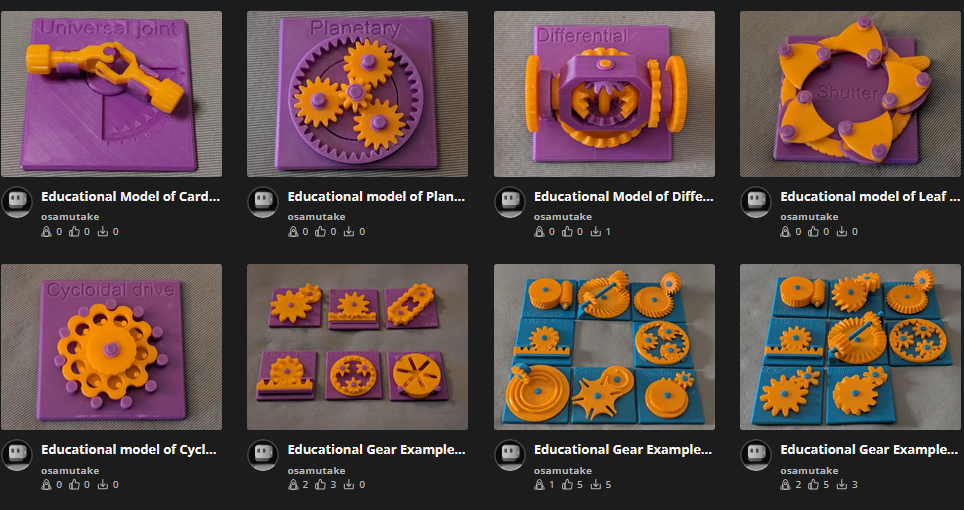
You can find all models of the series in this collection => [Mechanical Mechanism Examples]
The present model
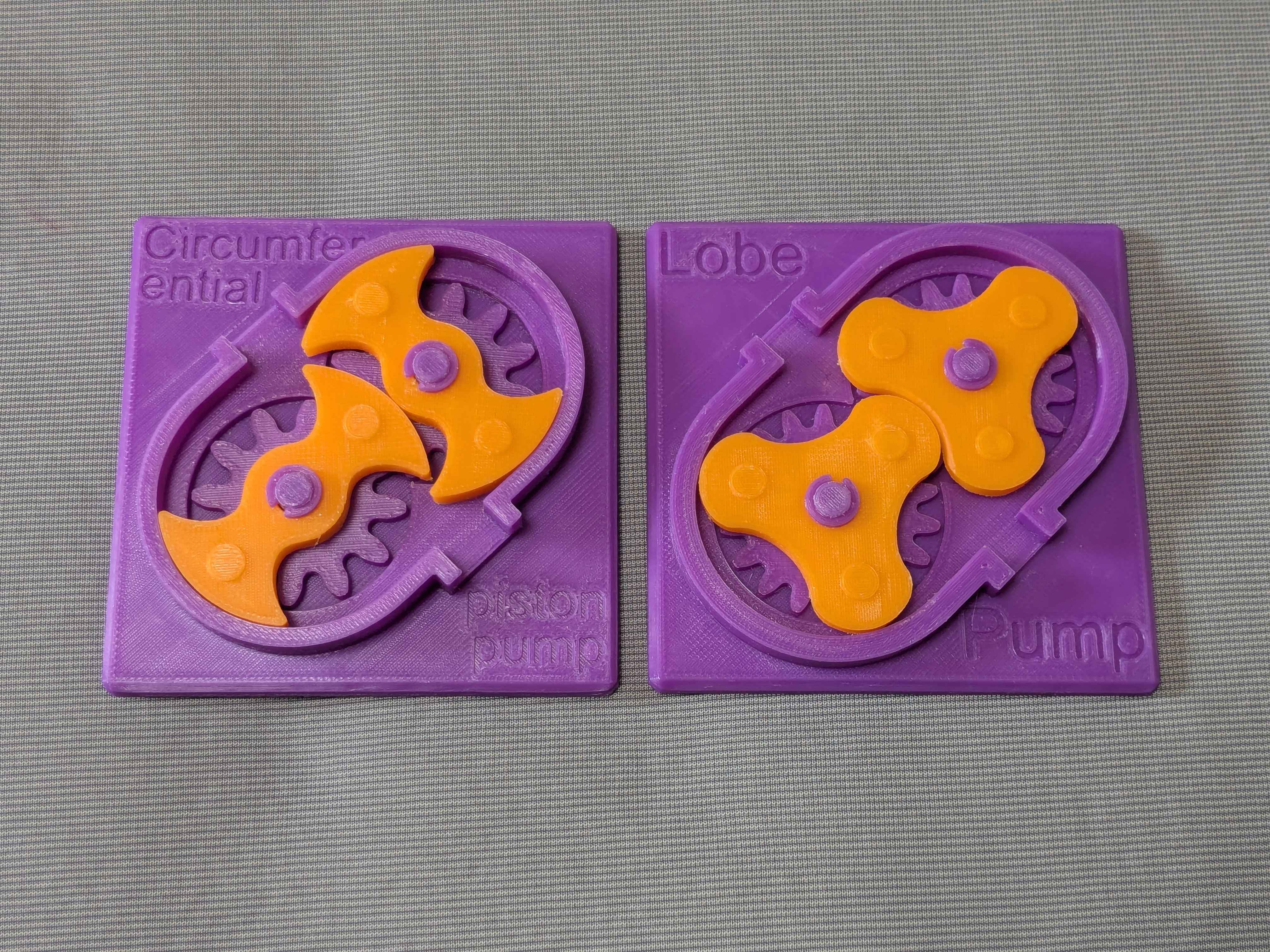
This is an educational models of two types of external gear pumps. One is a circumferential piston pump (left) and the other is a rotary lobe pump (right).
Brief Description
These pumps work on the same basic principle as an external involute gear pump, where fluid is trapped in sealed pockets between the casing and the rotating parts, and is carried from the inlet to the outlet as the rotors turn. Unlike an involute gear pump, however, the two rotors do not directly drive each other. They must be synchronized by separate timing gears. Because their rotor shapes are smoother and more open than involute gear teeth, these pumps are easier to clean and are widely used for hygienic fluids such as food and beverages.
In a circumferential piston pump, the outer portions of the rotors are formed by circular arcs that closely follow the casing. The central portions are also based on circular arcs that conform to the neighboring rotor. Because of this geometry, some trapped volume that moves fluid backward in the central region is unavoidable. The connecting portions between these arcs are therefore designed to minimize this reverse-transfer volume.
A rotary lobe pump, in contrast, can be designed so that such a central reverse-transfer volume does not appear. Its rotor shape has greater design freedom. In this model, the rotor profile is composed of circular arcs and trochoidal curves.
Comparing the two designs, the circumferential piston pump takes advantage of a longer sealing path between the rotor and the casing, which helps reduce leakage across the outer clearance. The rotary lobe pump, on the other hand, has less sealing length along the casing, but it avoids the reverse-transfer volume in the central region and can have a shape that is better suited for cleaning.
For this reason, circumferential piston pumps are advantageous in applications involving low-viscosity fluids and high pressure differences, where leakage through the outer clearance becomes important. Rotary lobe pumps are often preferred when the product is sensitive to shear and the clearance cannot be made very small—for example, when pumping yogurt, cream, emulsions, or liquids containing soft fruit pieces. In these products, strong shear in narrow gaps can crush soft pieces or disturb the internal structure of the fluid, which may change its texture and reduce its quality. In this way, each pump type is suited to different applications.
Related Models
References
Case
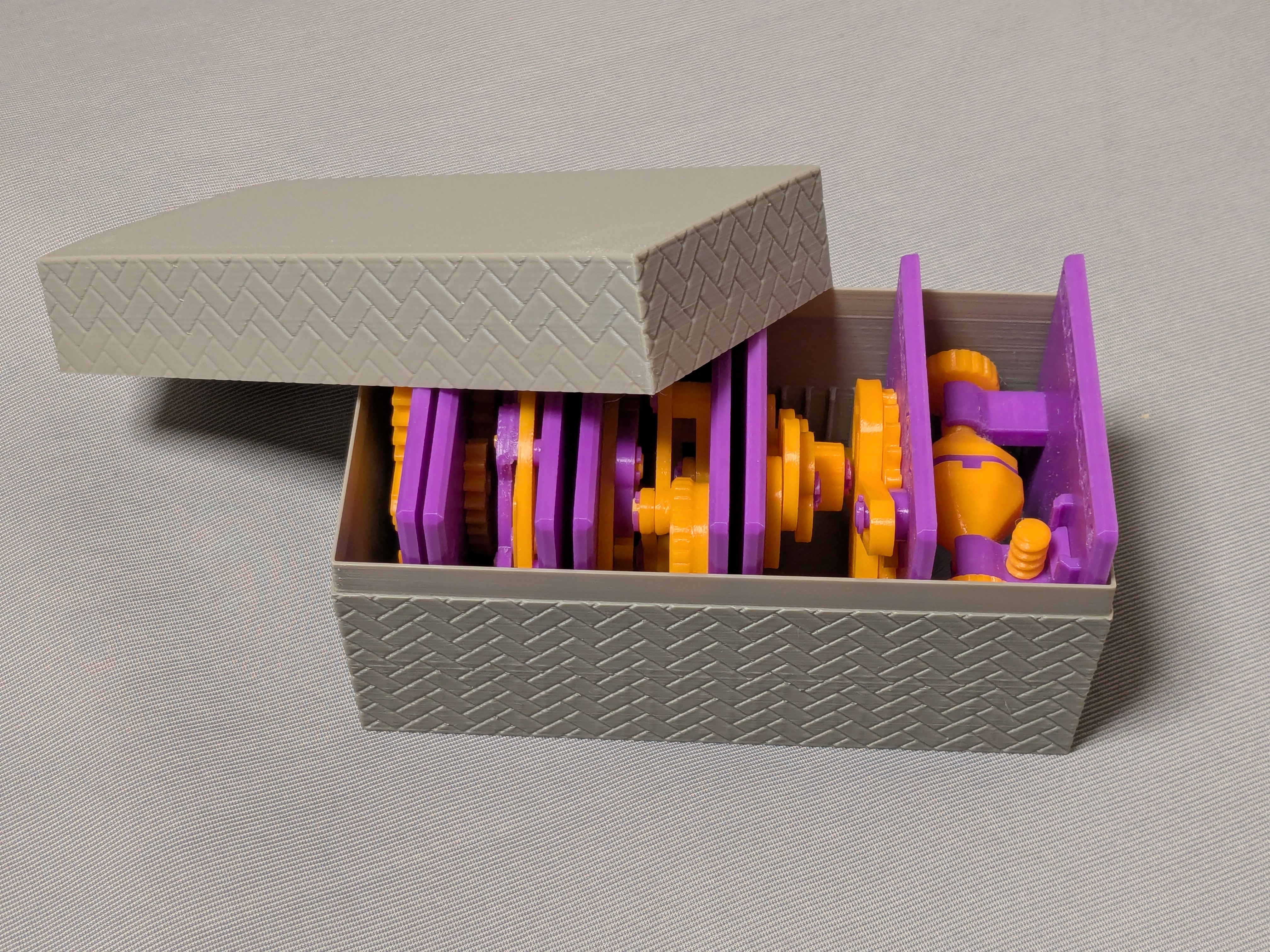
This model is compatible with the case included in my first set.
Printing
- Use the models named ???-printable.stl for printing.
The models named ???-assembled.stl are provided just to show how they should be assembled.
- Use well-dried PETG to have better dimensional accuracy.
- Use 0.1 mm or 0.08 mm layer height to have smoother surfaces.
- Use slow printing speed for overhangs.
- Select “Random” seam position to have smoother rotation.
Randomly distributed seam should be easily worn out after some wearing.Printing
Sanding and Filing
Note that, in this model, the rotation of the bases for bearings is intentionally made not too smooth.
Sometimes, the gears suffer from the stringing effect and/or elephant foot effect, resulting in a too tight fit to the shafts (they are designed with a 0.15 mm radial clearance).
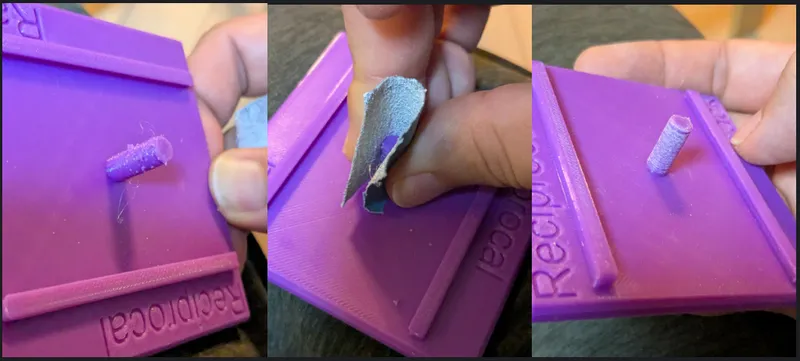
If you see rough surface on the shafts due to stringing, sand off the roughness with a small piece of sand paper.
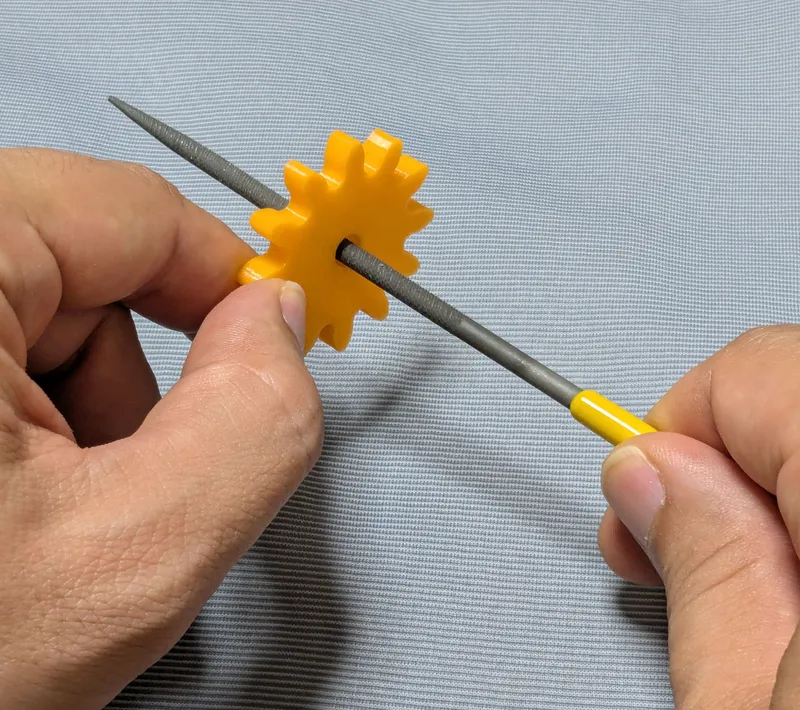
If you feel the gears do not rotate smoothly due to an elephant effect, widen the hole slightly by using a thin round bar file.
Without those issues, the parts should rotate very smoothly with minimal friction.
Assembly
Just secure the gears by the retaining rings.
Updates
- 2026-04-10 Lobe Pump v104
- Widen the central holes on the gears because they were too small, as @DougBurton1969 kindly pointed out.
Other examples
You may also be interested in the models in my educational mechanical mechanism examples.
Find them in this collection:
[https://makerworld.com/collections/15048577-my-educational-mechanism-models](https://makerworld.com/collections/15048577-my-educational-mechanism-models)
Happy printing!
Acknowledgement
I got into gears thanks to K.$uzuki's amazing articles and YouTube videos. Many of the mechanisms shown in this series came from the introductions on his website. He also makes excellent gear models himself. This series wouldn’t have existed without his inspiration.
I learned a lot about technical detail of designing gear tooth profiles from Haguruma-No-Hanashi website. I’m truly grateful for that.
License (2026-03-13 updated)
- The 3D model(s) are licensed under Creative Commons Attribution 4.0 International. (unchanged)
- However, the text and images on this page are copyright reserved. (added on 2026-03-13)
External Pumps - Educational Model

Publicado em 19 de mar de 2026
Gostou deste modelo? Crie uma conta grátis para salvar seus favoritos e voltar a eles depois.
Criar conta