Você está no 3DFinder
Buscamos em Thingiverse, MakerWorld e Printables ao mesmo tempo para te dar o melhor de cada uma.
Descrição
Notice!
This is only compatible with Python for the AMS 2 Pro. Please view my other designs for designs supporting other AMS systems, there are plenty.
Buy Python
I've teamed up with a few different stores around the world offering the printed parts and everything you need for the build so you won't need anything outside of the kit:
If you're interested in the panels only for the enclosure, you can buy them from LaserFoundry.
Python has a strict non-commercial license, it can only be sold with licensing through Hume Beam Engineering Solutions.
About
This is an actively heated enclosure for Python. It can be used with up to four PolyMaker PolyDryers. There is also an Passively Dried Enclosure available. The printed parts are actually the same, it's just the front and rear panels that are different but I prefer to keep them apart for different reasons.
For most user cases, one or two dryers should be sufficient but it depends on what type of filament you often print as well as the humidity of the area where you like.
Support for more types of heaters may be added later on.
It's a good idea to also use the Python - Silica Gel Boxes to maintain low humidity inside the box when the dryers are inactive.
The size of the enclosure is 460.0 mm (width) x 390.5 mm (depth) x 293.0 mm (height).
How effective is it?
In my experiment, with three fully dried silica gel containers, a near full Prusament PETG spool in a Python spool holder dropped from 1233 g to 1171 g, 62 grams! Two PolyDryers used at the max setting for 6 hours, one rear mounted and one front mounted.
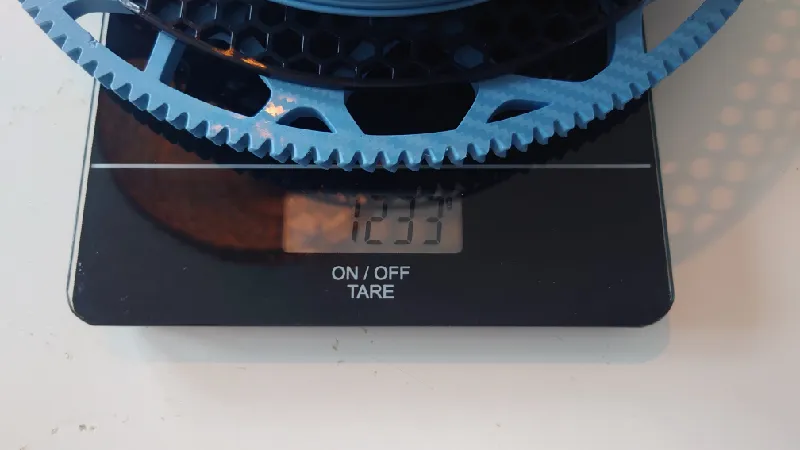
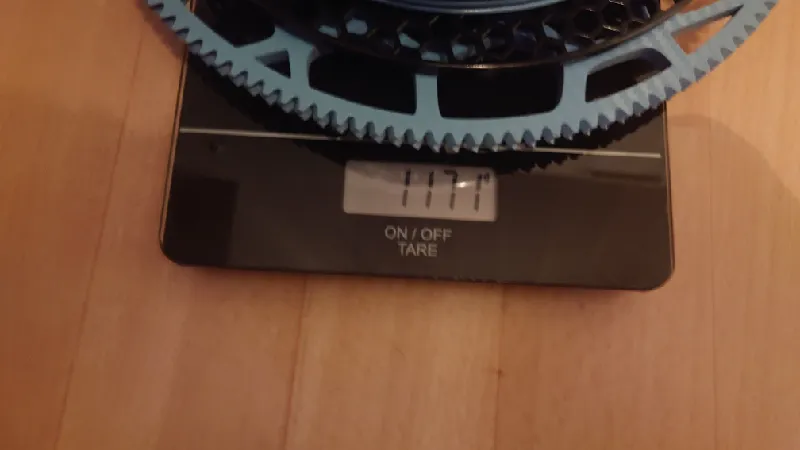
Just using the dryers without the silica gel boxes is not nearly as effective so don't forget to use those with dried silica gel.
Likewise, having silica gel in the enclosure will keep the relative humidity at a minimum and keep the spools dry but to actually dry the spools, both dry silica gel and heaters must be used.
How many dryers should I use?
It depends on your usage. For most, two PolyDryers should be sufficient.
Support
All my designs and mods are free to use and remix. They have a non-commercial license. If you enjoy this or any of my other designs you can send me a small donation using the link below. Thanks :)
[https://www.paypal.me/humebeamengineering](https://www.paypal.me/humebeamengineering)
BOM - Bill of Materials
I recommend using two PolyDryers, this should be sufficient for most. For Python you actually only need the dryer and not the plastic container so you can save some money that way:
You can later add in up to two more PolyDryers.
Filament
I suggest printing the enclosure in PETG, ABS, ASA, PA or PC as it can get pretty hot inside the enclosure when the dryers have been running for a while so PLA will likely deform due to the heat.
Around 1 Kg of filament is required at the recommended print settings.
I've printed most of the test builds in Prusament ASA and Prusament PC-CF.
Panels
- 3 mm Acrylic or PC panels cut according to the included DXF drawings.
Fasteners
The following M3 socket heads are required:
- Top screw holes (with the edges): 16 x M3-12 mm
- Middle screw holes 8 x M3-10 mm
- Lower screw holes : 20 x M3-10 mm
- Bottom of the enclosure (dovetails): 8 x M3-25 mm
- Handle: 4 x M3-16 mm
- Attaching the bottom panel: 6 x M3-8 mm
- Optionally securing Python to the enclosure: 4 x M3-16 mm
- Front vent: 4 x M3-12 mm
- Rear vent: 4 x M3-12 mm
To summarize, the follow M3 socket heads are needed:
- 6 x M3-8 mm
- 28 x M3-10 mm
- 24 x M3-12 mm
- 8 x M3-16 mm
- 8 x M3-25 mm
If you don't have any at home it's best to grab the kit below, it will have everything you need for this build and more:
Magnets
8 pcs of round 6 x 3 mm Neodymium Magnets are required.
Tools and others
Print Settings
Notice! If using heated inserts, print the files in the heated-inserts-version instead.
All parts print without supports and I recommend using 3 walls and an infill of around 15%. Print all parts in the direction I have set them.
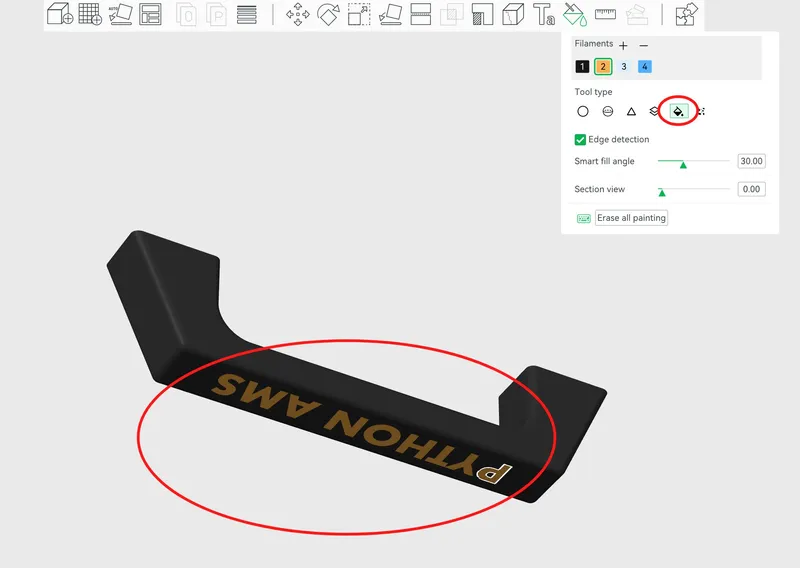
The handle has the text “Python AMS” hidden in the first layer that you can paint with your AMS if you like, use the Paint Bucket Tool in Bambu Studio:
Print one of each part except for the M14 plugs (see section at the bottom), polydryer-cutout-gasket-lock-1.00.3mf, enclosure-cutout-seal-rear-1.00.3mf and enclosure-cutout-seal-front-1.00.3mf.
The gasket lock installs on the inside of the enclosure to lock the PolyDryer in place so for one dryer you need two of these, depends on the number of dryers you use of course: polydryer-cutout-gasket-lock-1.00.3mf
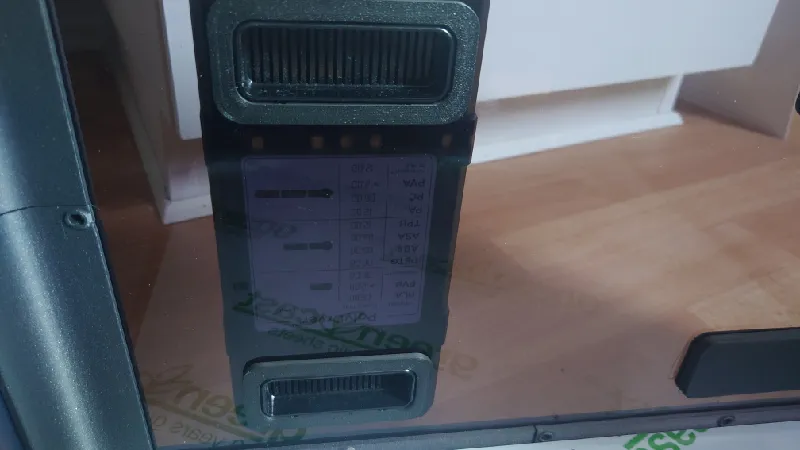
Be aware that the gasket locks may not fully support the weight of the PolyDryer as the “tabs” on the dryers are so short so in addition to the gasket locks I would suggest using double sided tape on the dryer against the panel, I use 3M 4229P VHB myself.
What about the enclosure cutout seals? They're used in the enclosure cutouts where you don't use any dryer, it's to fully seal the enclosure. Let's say you just want to try with two PolyDryers first and place them in the front of the enclosure. You then must seal up the rear cutouts with the cutout seals. So print as many of these (front + rear of each) you need for your setup.
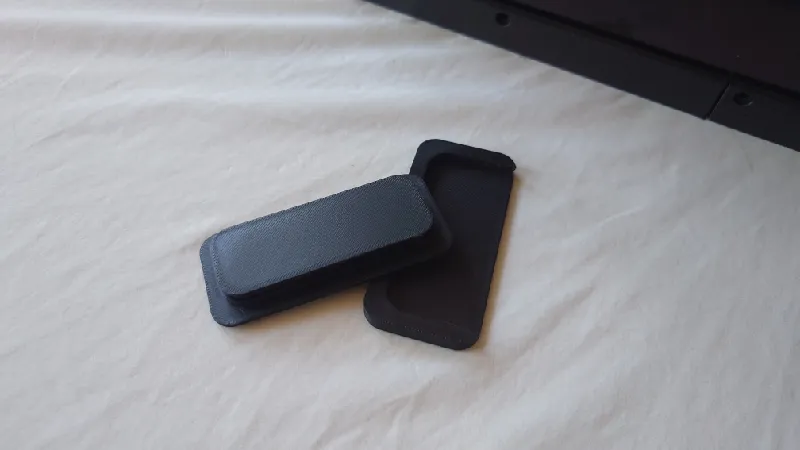
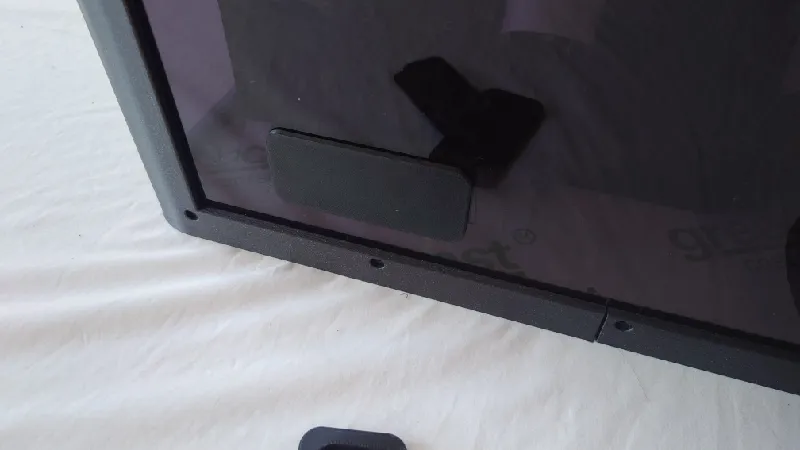
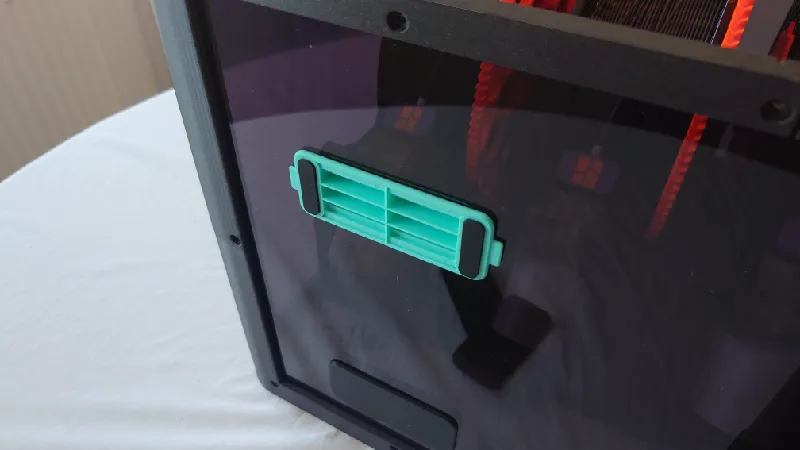
The cutouts in the panels are also compatible with the airlocks that come with the PolyDryer, two of them are included with a single Polydryer.
Assembly Guide
Please download the attached assembly guide (PDF).
Python - Actively Heated Enclosure

Publicado em 29 de jul de 2025