Você está no 3DFinder
Buscamos em Thingiverse, MakerWorld e Printables ao mesmo tempo para te dar o melhor de cada uma.
Descrição
Chemically Accurate Dopamine
To my knowledge, the presented 3D model is the most accurate representation of dopamine.
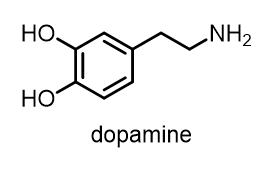
Methods
Model was generated with a custom Python script with the RDKit module, and the STL file was rendered in OpenSCAD. Atom coordinates, and therefore bond lengths, atom radii and overall shape of the molecule, were calculated with the Merck Molecular Force Field.
Force fields are mathematical models used to describe the interactions between atoms and molecules. They are based on empirical parameters that represent the forces and energies associated with different types of atomic interactions, such as bond stretching, angle bending, and non-bonded interactions. These parameters are derived from experimental data and quantum mechanical calculations.
Notes
- I decided to go with the ball-and-stick type, as it is easiest to color, is rigid, and looks awesome.
- Aromatic bonds are modeled as single stick but 1.5x thicker to represent ~1.5 bond order.
- I oriented the model for optimal strength/waste/time compromise, but if you decide to reorient it, try to avoid placing bonds along the Z-axis, as they will be very easy to break.
- You can choose from two models: one with hydrogens and one without.
- For support settings, see Figure 1. Supports removable without too much worry of damaging model if you are careful with scalpel and do of paper-sanding afterwards.
- You can use PETG as support material (don't forget to set the heatbed to 70 °C!) and PLA for the model itself (the support then come off much easier). For extra swag, use PLA support filament or PVA as supports.
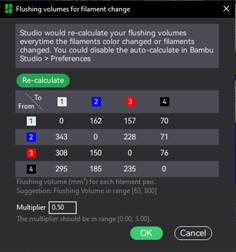
- Recommended colorization is based on the Corey–Pauling–Koltun (CPK) palette (Figure 2). To quickly change atom colors, use the settings depicted in Figure 3.
Alternatively, if you want to save filament and time, print the model in full-white and paint it with a permanent marker.
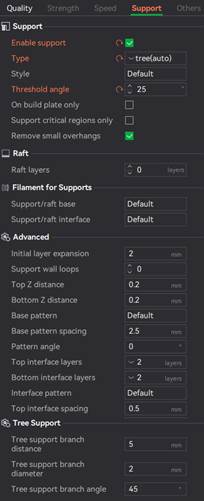
Figure 1. Support page settings
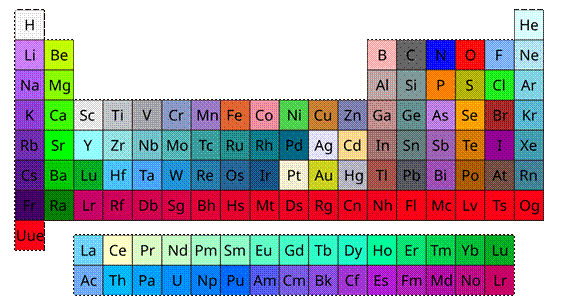
Figure 2. Recommended palette based on CPK coloring.
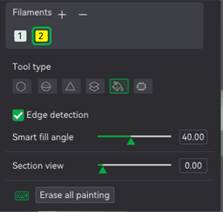
Figure 3. Setting to quickly color atoms with one click.
 Happy printing!
Gostou deste modelo? Crie uma conta grátis para salvar seus favoritos e voltar a eles depois.
Criar conta